
7 Tips for How To Get Your First Visa With Pakistani Passport
PardesRaah
7/22/20268 min read
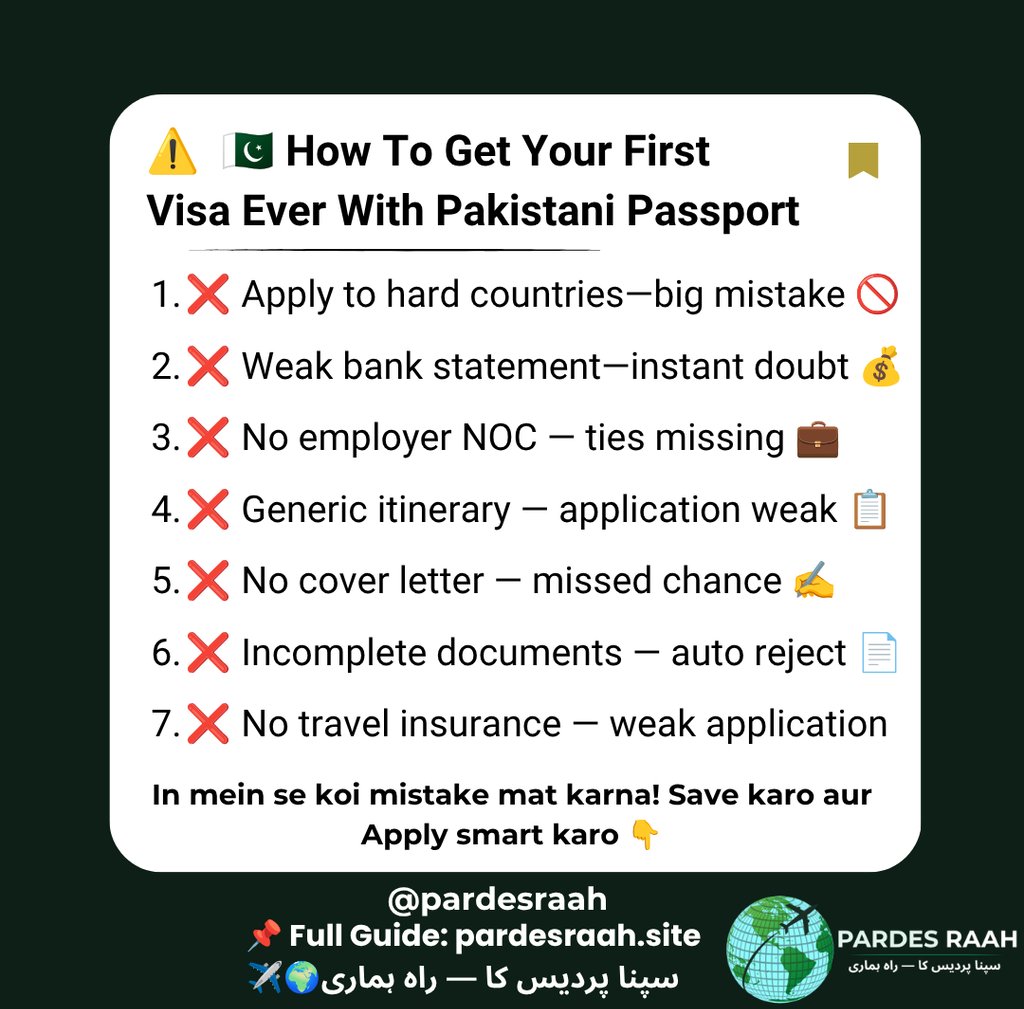
Har bade safar ka pehla qadam hota hai — aur sahi tayyari se yeh pehla qadam aaramse uthaya ja sakta hai.
How To Get Your First Visa Ever With Pakistani Passport (7 Tips)
Introduction:
Getting your first international visa as a Pakistani passport holder is one of the most important and strategically consequential immigration decisions you will ever make. The reason it matters so much is not just about the single trip you are planning — it is about the travel history foundation you are laying that will either strengthen or weaken every subsequent visa application for years to come. A successful first visa opens a door. A first visa rejection creates a record that must be declared on future applications and that can complicate your visa journey for years. Pakistani passport holders who approach their first visa application with the right strategy, the right destination choice, and the right document preparation give themselves the best possible start to building an international travel profile that progressively opens more and more of the world to them. This guide presents 7 essential tips every Pakistani applicant should follow when applying for their very first international visa in 2026.
Why the First Visa Is So Important for Pakistani Passport Holders:
Pakistani passport holders face a uniquely challenging immigration environment. With a passport ranked 100th globally with access to only 30 destinations without prior visa arrangement, Pakistani applicants are assessed with higher baseline scrutiny than applicants from stronger passport countries. This scrutiny is compounded for first-time applicants who have no existing travel history — no prior stamps, no evidence of previous compliance with visa conditions, no track record of returning home on time after international trips. Visa officers reviewing first-time Pakistani applications are essentially being asked to trust a completely unknown travel profile. The strategies in this guide are specifically designed to build maximum credibility into a first-time Pakistani visa application to overcome this trust deficit.
Who Should Read This Guide?
This guide is for Pakistani nationals who have never held an international visa before and are planning to apply for their first, and for Pakistani applicants who want to understand why their first-time applications have previously been rejected and how to approach a reapplication more strategically.
Tip 1: Start With the Easiest and Most Accessible Countries
The most important strategic decision for a first-time Pakistani visa applicant is choosing the right destination. Many Pakistani applicants make the mistake of attempting Schengen visas, UK visit visas, or US B1/B2 visas as their very first international visa application — destinations that have high scrutiny levels for Pakistani applicants, require strong travel history evidence, and have meaningful rejection rates even for well-prepared applications from experienced travelers. For a first-time Pakistani applicant with a blank passport, these are the wrong starting points.
The right starting destinations for Pakistani applicants with no prior travel history are the countries with the highest approval rates and the most accessible application processes. Turkey offers a straightforward e-Visa at evisa.gov.tr for just $51 with approvals typically arriving within 3 to 5 days and a high approval rate for Pakistani applicants who hold valid US, UK, or Schengen visas. Malaysia offers the eVisa at malaysiavisa.imi.gov.my for RM 200 with approvals frequently arriving within 24 hours and one of the most accessible visa systems for Pakistani passport holders. The UAE offers various visit visa options with relatively accessible processing. The Maldives offers visa on arrival for Pakistani passport holders. Nepal offers a visa on arrival. Performing Umrah is also an excellent first international experience that adds meaningful stamps and demonstrates responsible international travel.
Starting with one or two of these accessible destinations, visiting cleanly, and returning home on time before the visa expires creates the travel history foundation that makes every subsequent visa application stronger.
Tip 2: Build a Strong and Consistent Bank Statement
A strong bank statement is the financial backbone of any visa application and for a first-time Pakistani applicant it carries particularly high importance because it is one of the primary tools available to compensate for the absence of travel history. A bank statement that shows a consistent, genuine, and adequately maintained balance over 3 to 6 months before the application date tells the visa officer that the applicant is financially stable and has genuinely planned for the trip.
The most damaging bank statement error a first-time Pakistani applicant can make is a sudden large deposit made shortly before the application date — depositing PKR 500,000 one week before applying when the previous months show minimal balance. This pattern is immediately recognizable to experienced visa officers as a borrowed balance and actively hurts rather than helps the application. The correct approach is to begin building and maintaining the required balance 3 to 6 months before the planned application date, allowing it to grow gradually through legitimate salary credits and savings rather than sudden transfers. The bank statement must be printed on official bank letterhead, stamped, and signed — internet banking printouts are not accepted.
Tip 3: Get a Strong Employer NOC
For employed Pakistani applicants the employer No Objection Certificate is the most powerful single document for demonstrating ties to Pakistan — the key factor that tells the visa officer why you will return home after your trip. A strong NOC from a Pakistani employer proves that you have a job waiting for you in Pakistan, that your employer knows about your trip and has approved it, and that you have a compelling professional reason to return by a specific date.
The NOC must be on official company letterhead, signed by an authorized company representative, and must state your name, job title, monthly salary, years of service, approved leave dates, and a clear statement that the company expects your return. For first-time visa applicants who are self-employed the equivalent is a comprehensive set of business documents — registration certificate, tax returns, business bank statement, and a personal business letter — that collectively demonstrate a business in Pakistan that depends on the owner's active involvement and return. Students applying for their first visa should provide a university enrollment certificate and financial sponsorship documents from parents or guardians.
Tip 4: Submit a Specific and Detailed Itinerary
A day-by-day itinerary that covers every day of the planned trip is a document that many first-time Pakistani applicants either skip entirely or complete in a generic and unconvincing way. A vague itinerary that simply says planning to visit Turkey for 10 days tells the visa officer nothing about the genuine nature of the planned trip. A specific day-by-day itinerary that lists exact hotel names and addresses, confirmed flight details, specific attractions or activities planned for each day, and the total planned budget for the trip tells a completely different story.
For a first-time Pakistani applicant, a specific itinerary serves multiple purposes simultaneously. It demonstrates genuine trip planning rather than a vague intention to visit. It is consistent with the hotel bookings and flight tickets submitted as supporting documents, creating a coherent and verifiable application narrative. And it shows the visa officer a clear beginning, middle, and end to the visit — with a specific return date that leaves no ambiguity about when and why the applicant will leave.
Tip 5: Write a Personal Cover Letter
The personal cover letter is the single most underutilized document in first-time Pakistani visa applications — and for applicants with no travel history it is potentially the most impactful tool available. In the absence of travel history stamps that speak for themselves, the cover letter is the applicant's direct opportunity to address the visa officer's central question — why will this person return to Pakistan — with a personal, specific, and compelling narrative.
A strong first-visa cover letter should introduce the applicant by name and profession, explain the specific purpose and dates of the planned trip, describe each key aspect of the application — the financial position, the employment or business ties, the family situation, and any property or other Pakistan-based commitments — and close with a direct statement of intention to return to Pakistan at the end of the trip. The letter should be 1 to 1.5 pages, professionally formatted, grammatically correct, and personally signed. For first-time applicants it should explicitly acknowledge that this is a first international trip and proactively address any concerns the absence of travel history might raise by emphasizing the strength of other ties.
Tip 6: Ensure Your Document File Is 100% Complete
First-time Pakistani visa applications are rejected for incomplete documents more frequently than for any other single reason. Every visa has a specific document checklist published by the issuing embassy or the visa application centre — and every single item on that checklist must be present, correctly formatted, and properly prepared before the application is submitted.
Before submitting any first visa application Pakistani applicants should create a physical document checklist matched to the specific visa they are applying for, physically place every required document on the checklist side by side, verify each document against the issuing authority's requirements for format and recency, and have a trusted second person review the complete file before submission. Missing a single document — particularly a mandatory one like a TB test certificate for UK or Schengen visas, or an APS certificate for Germany — results in the application being returned or rejected regardless of how strong all the other documents are.
Tip 7: Purchase Travel Insurance and Apply at the Right Time
Travel insurance is a mandatory requirement for Schengen visa applications and strongly recommended for all other destinations. For first-time Pakistani applicants, including travel insurance in the application — even when it is not mandatory — signals responsible and professional travel preparation and adds a small but meaningful positive element to the application assessment.
The policy should cover the full duration of the planned trip, include medical emergency and hospitalisation coverage of at least €30,000 or equivalent for Schengen, and show the applicant's name exactly as it appears in the passport. Pakistani insurance providers including Jubilee and EFU offer international travel insurance policies starting from approximately PKR 5,000 for a 2-week trip.
The timing of the visa application also matters. Applying during peak tourist seasons — particularly June to August for European visas — means longer appointment waiting times, higher processing volumes, and in some cases more intensive scrutiny. Pakistani applicants who have flexibility in their travel dates should consider applying during January to March or October to November when VFS appointment slots are more readily available, processing is faster, and visa officers are working through lower volumes of applications.
The Recommended First Visa Pathway for Pakistani Applicants:
For most Pakistani applicants with no existing travel history the recommended first visa pathway in 2026 is as follows. Start with Turkey e-Visa or Malaysia eVisa as the first international trip. Visit, comply with all visa conditions, and return to Pakistan on time before the visa expires. Use this first stamp as supporting evidence when applying for the next destination — another accessible country such as UAE, Maldives, Nepal, or Umrah. After 2 to 3 clean international trips, apply for slightly more demanding destinations such as other Gulf countries or accessible Asian destinations. After establishing a clean 3 to 5 trip travel history apply for Schengen, UK, or other premium destinations with the full weight of a proven compliance record behind the application.
Processing Time Context:
Turkey e-Visa processing takes 3 to 5 days. Malaysia eVisa processing takes 24 hours to 3 days. Standard Schengen visa processing takes 15 to 20 working days. UK Visit Visa processing takes approximately 3 weeks. Pakistani applicants should always apply well before their intended travel date — at least 3 to 4 weeks for easier destinations and 6 to 8 weeks for Schengen and UK applications.
Important Tips:
Never apply for a visa to a destination you genuinely do not intend to visit — misrepresentation on any visa application has consequences that extend far beyond the immediate application. Always verify the specific document checklist for the visa you are applying for directly from the official embassy or visa application centre website rather than relying on social media groups or informal advice. If your first visa application is rejected, request the rejection letter and read it carefully — the stated reason directly tells you what to improve for the reapplication. Never pay anyone to guarantee a visa — no legitimate service can guarantee visa approval, and claims of guaranteed approvals are a red flag for fraud.
Conclusion:
Getting your first visa with a Pakistani passport in 2026 is entirely achievable with the right strategy, the right destination choice, and the right preparation. Start with Turkey or Malaysia where your approval chances are highest, build a consistent bank statement over months before applying, get a strong employer NOC, write a specific itinerary and a compelling personal cover letter, ensure your documents are 100% complete, include travel insurance, and apply during off-peak seasons for faster processing. Every clean visa and every on-time return to Pakistan adds to a travel history that makes the next application stronger — and the one after that stronger still. The world is accessible to Pakistani passport holders who build their travel profile correctly from the very first step.
For free visa guides, document checklists, and daily immigration updates made for Pakistani applicants follow PardesRaah on YouTube, Instagram, Facebook, TikTok and X.
سپنا پردیس کا — راہ ہماری ✈️🌍
© PardesRaah — Pakistan's #1 Visa & Immigration Media Hub


Sapna Pardes Ka — Raah Humari
Pakistan's free daily visa and immigration information hub.
Har roz naye guides — bilkul free.
Quick Links
Visa Categories
Popular Countries
© 2026 PardesRaah. All rights reserved.
Disclaimer: All information on PardesRaah is for educational purposes only. We are not immigration lawyers or consultants.