
Australia PR vs Work Visa for Pakistanis in 2026
PardesRaah
6/8/20269 min read
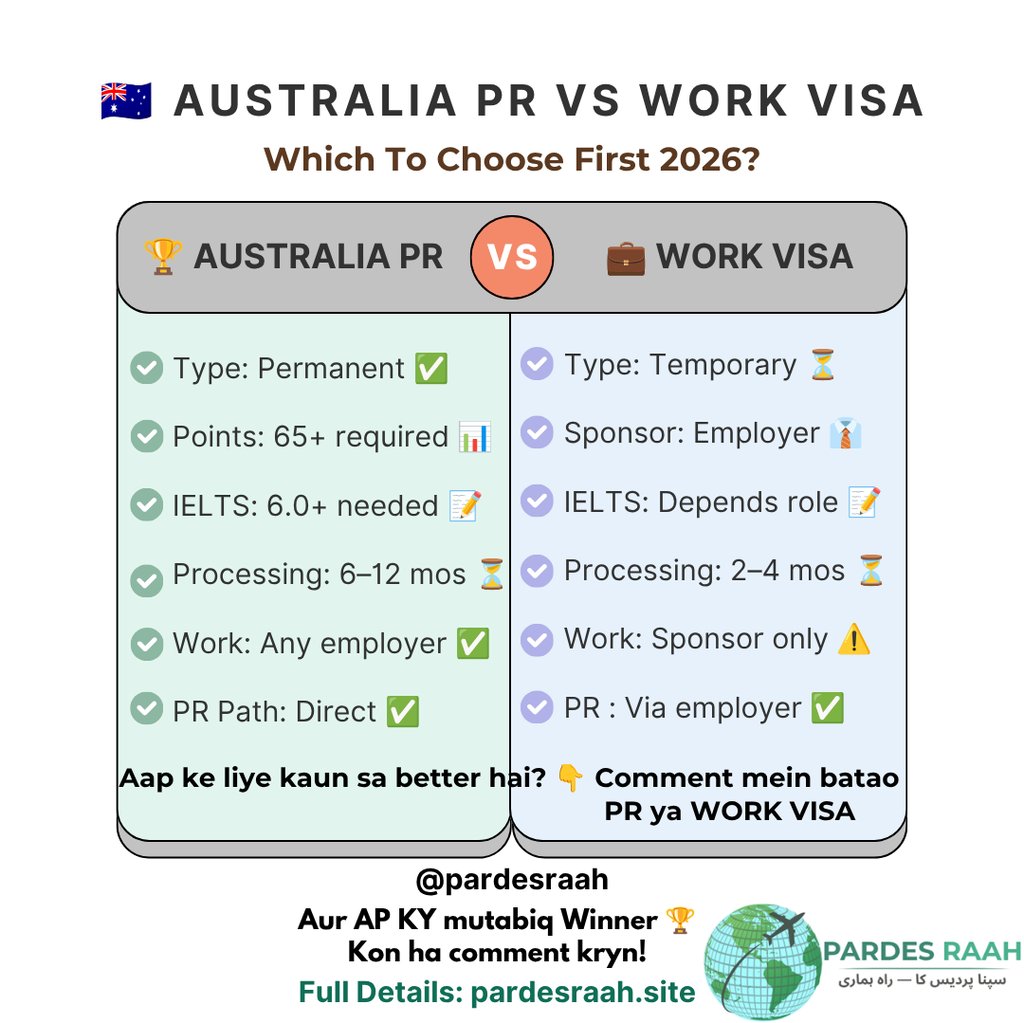
Australia mein permanent settle hone ka sapna — sahi raah choose karne se shuru hota hai.
Australia PR vs Australia Work Visa — Which To Choose First
Introduction:
Australia is one of the most aspirational immigration destinations for Pakistani skilled professionals in 2026. With a strong economy, exceptional quality of life, world-class healthcare and education systems, and one of the most transparent and merit-based immigration frameworks in the world — Australia offers Pakistani professionals a genuine opportunity to build a permanent and prosperous life for themselves and their families. But one of the most important and consequential decisions a Pakistani professional planning to move to Australia must make is whether to pursue Australian Permanent Residency directly through the skilled migration points system or to first secure a temporary Australian Work Visa through employer sponsorship. Both pathways lead to Australia. Both can lead to permanent settlement. But they work through entirely different mechanisms, suit different professional profiles, involve different timelines and costs, and carry different levels of flexibility and security. This guide gives Pakistani professionals a complete, honest, and detailed comparison of both options so you can choose the right first step for your Australian journey in 2026.
What Is Australian Permanent Residency(PR) Through Skilled Migration?
Australian Permanent Residency(PR) through the skilled migration pathway is a permanent visa granted to qualified professionals who score sufficient points under Australia's points-based immigration system. The primary visa subclasses under this pathway are Subclass 189 — the Skilled Independent Visa — which requires no employer sponsor or state nomination and is open to applicants who score high enough points to receive an invitation from the general pool, Subclass 190 — the Skilled Nominated Visa — which requires a nomination from an Australian state or territory government and adds 5 extra points to the applicant's score, and Subclass 491 — the Skilled Work Regional Visa — which is a temporary visa that leads to PR after 3 years of living and working in a regional area of Australia. All three require a minimum of 65 points under Australia's points test to submit an Expression of Interest through the SkillSelect system at immi.homeaffairs.gov.au.
What Is the Australian Work Visa?
The Australian Work Visa through employer sponsorship primarily refers to the Temporary Skill Shortage Visa, known as Subclass 482, which allows Australian employers to sponsor skilled overseas workers to fill positions they cannot fill from the Australian labour market. Pakistani professionals who receive a job offer from an approved Australian employer can apply for the Subclass 482 visa which is granted for 2 to 4 years depending on the occupation stream. After working for the sponsoring employer for a qualifying period — typically 2 to 3 years — Subclass 482 holders in eligible occupations can apply for employer-sponsored permanent residency through the Employer Nomination Scheme, known as Subclass 186, or the Regional Sponsored Migration Scheme, known as Subclass 187, which converts their temporary work visa into permanent residency.
Who Should Read This Guide?
This guide is for Pakistani skilled professionals who are planning to immigrate to Australia in 2026 and need to understand which pathway — direct PR through points or temporary work visa through employer sponsorship — is more appropriate for their specific qualifications, experience, and circumstances. It is also useful for Pakistani professionals who are currently evaluating their points score and want to understand whether they should pursue direct PR or explore employer sponsorship as an alternative route.
Type of Visa — Permanent vs Temporary:
The most fundamental difference between the two pathways is the permanence of the visa granted.
Australian Permanent Residency(PR) through the Subclass 189, 190, or 491 pathway grants the holder the right to live and work in Australia permanently — or in the case of Subclass 491, for 5 years with a pathway to permanent residency after 3 years. A Pakistani PR holder can work for any employer in Australia, access most government services, sponsor eligible family members for permanent residency, and apply for Australian citizenship after 4 years of residence including 1 year as a permanent resident.
The Australian Work Visa through Subclass 482 is a temporary visa that ties the Pakistani worker to their sponsoring employer. It grants the right to live and work in Australia for the visa's duration but does not immediately confer permanent status or the freedom to change employers without a visa transfer process. The temporary nature of the work visa means Pakistani workers on this pathway must maintain a positive relationship with their sponsoring employer throughout the visa period — losing or leaving the sponsored job means the visa may be cancelled and the worker must find a new sponsor or leave Australia.
Points System vs Employer Sponsorship:
The pathways use fundamentally different selection mechanisms.
Australian PR through skilled migration uses a points-based system that assesses Pakistani applicants on age, English language proficiency, educational qualifications, years of skilled work experience, whether they have a partner with skills, whether they have Australian study experience, and whether they have a state nomination or a credentialed community language. The minimum threshold to submit an Expression of Interest is 65 points but the actual invitation cutoff in competitive draws is significantly higher — typically 85 to 95 or more points for the Subclass 189 in 2026 depending on the occupation.
For Pakistani professionals to calculate their points score they should use the official Australian Points Calculator at immi.homeaffairs.gov.au. Pakistani applicants who are under 33 years of age, hold a bachelor's degree or higher, have at least 8 years of relevant work experience, and achieve IELTS scores of 8 or above in all four bands can achieve very competitive points scores that make direct PR a realistic goal. Pakistani applicants who fall short of the competitive cutoff scores needed for invitation must either work on improving their profile — through higher IELTS scores, additional qualifications, or more documented work experience — or consider the employer sponsorship pathway as an alternative route to Australia.
The employer sponsorship pathway does not use a points system. Instead it requires a Pakistani professional to secure a job offer from an Australian employer who is approved to sponsor overseas workers, whose business is genuine and actively operating in Australia, and who has demonstrated that the position cannot be filled from the Australian labour market. The job must be on Australia's eligible skilled occupation list and must meet the minimum salary requirements for the Subclass 482 visa. Pakistani professionals with highly in-demand skills — particularly in IT, engineering, healthcare, construction, and hospitality — are most likely to secure Australian employer sponsorship in 2026.
Processing Time:
Processing time is an important practical consideration for Pakistani professionals who want to move to Australia as soon as possible.
Australian PR through skilled migration involves two main phases — the Expression of Interest submission and wait for an invitation, followed by the actual visa application processing. The wait for an invitation from the general pool for Subclass 189 can range from a few months to over a year depending on the applicant's points score and occupation. Once an invitation is received and the full application is submitted, processing takes 6 to 12 months for most applications. Total time from EOI submission to PR grant can range from 12 to 24 months or more for some Pakistani applicants.
The Australian Work Visa through Subclass 482 offers a faster initial pathway to arriving in Australia. Once a Pakistani professional has a job offer from an approved Australian employer, the Subclass 482 application is typically processed within 2 to 4 months. This means a Pakistani professional who secures an Australian job offer today can potentially be living and working in Australia within 3 to 5 months — significantly faster than the PR pathway. For Pakistani professionals with urgent career opportunities in Australia or specific job offers in hand, the Work Visa offers a faster route to arrival even if the path to permanent residency ultimately takes longer.
Work Freedom and Flexibility:
An Australian PR holder enjoys complete and unrestricted work freedom throughout Australia. They can work for any employer in any location, change jobs freely, start their own business, work in multiple jobs simultaneously, and switch industries without any visa implications. This freedom is one of the most valuable aspects of Australian PR for Pakistani professionals who want maximum career flexibility.
A Subclass 482 Work Visa holder's work rights are tied to their sponsoring employer. They can only work in the specific position for which they were sponsored, at the employer who sponsored them, and in the location specified in their sponsorship. If a Pakistani professional on a Subclass 482 visa wants to change employers, their new employer must also be an approved sponsor and must file a new sponsorship and nomination application. Changing jobs without completing this process would breach visa conditions. While there is a grace period of 60 days allowed for Subclass 482 holders to find a new sponsor if they lose their job, this dependency on employer sponsorship represents a significant constraint on professional freedom compared to PR status.
PR Pathway:
Both pathways can ultimately lead to Australian permanent residency for Pakistani professionals. The skilled migration PR pathway grants permanent status immediately upon visa grant — there is no additional waiting period or intermediate step between receiving the Subclass 189 or 190 visa and being a permanent resident. Pakistani PR holders can apply for Australian citizenship after 4 years of residence including at least 1 year as a permanent resident.
The Work Visa PR pathway requires an additional step after the initial Subclass 482 period. After working for their sponsoring employer for typically 2 to 3 years in a medium-term stream occupation, Subclass 482 holders become eligible for their employer to nominate them for permanent residency through the Employer Nomination Scheme Subclass 186 Direct Entry or Temporary Residence Transition stream. The Subclass 186 processing time is currently 6 to 12 months. Total time from arriving in Australia on a Subclass 482 to receiving permanent residency through employer nomination is typically 3 to 5 years.
Which Pathway Is Right For You?
The right choice depends entirely on your individual profile, qualifications, and circumstances. If you have a strong points score of 85 or above, excellent IELTS scores, and relevant work experience in a high-demand occupation — direct PR through Subclass 189 or 190 is the stronger and more independent pathway that grants immediate permanent status without employer dependency. If your points score falls below the competitive cutoff, if you have a specific Australian job offer in hand, or if you want to arrive in Australia faster — the Subclass 482 Work Visa followed by employer-sponsored PR through Subclass 186 is a well-established and proven alternative pathway. Many Pakistani professionals who could not immediately achieve direct PR have successfully used the Subclass 482 pathway to build their Australian career and ultimately achieve permanent residency through their employer.
Documents Required:
For Australian PR through skilled migration Pakistani applicants need a valid passport, skills assessment from the relevant assessing authority for their occupation, IELTS or PTE Academic scores meeting the minimum requirements, educational degree certificates and transcripts attested as required, proof of work experience including employment reference letters, position descriptions, and payslips, police clearance certificate, and completed health examination by an approved panel physician. Applications are submitted through ImmiAccount at immi.homeaffairs.gov.au.
For the Australian Subclass 482 Work Visa Pakistani applicants need a valid passport, a sponsorship approval from an approved Australian employer, a nomination approval for the specific position, a valid skills assessment for some occupations, IELTS or equivalent English test results meeting the occupation requirement, proof of work experience, health examination results, and police clearance certificate. Applications are also submitted through ImmiAccount.
Fees and Costs:
The Australian Subclass 189 PR visa application fee is AUD 4,640 for the primary applicant which is approximately PKR 788,800 at current exchange rates. Additional applicants including a spouse pay AUD 2,320 each and children pay AUD 1,160 each. The Subclass 190 fee is also AUD 4,640 for the primary applicant. The Subclass 482 Work Visa fee is AUD 3,035 for a 4-year grant which is approximately PKR 515,950. Skills assessment fees vary by occupation and assessing authority but typically range from AUD 300 to AUD 1,000. Health examination fees in Pakistan are approximately PKR 15,000 to PKR 25,000. Police clearance fees are approximately PKR 1,000 from NADRA.
Processing Time Summary:
Australian PR through skilled migration takes 6 to 12 months after invitation and full application submission. The wait for an invitation from the SkillSelect pool varies from months to over a year depending on points score and occupation.
The Subclass 482 Work Visa takes 2 to 4 months from complete application submission. The subsequent Subclass 186 employer-nominated PR application takes 6 to 12 months.
Important Tips:
Calculate your current points score accurately using the official Australian Points Calculator before deciding which pathway to pursue. If your score is close to but not yet at the competitive cutoff, consider whether a higher IELTS score or state nomination could push you above the threshold before committing to the Work Visa pathway. For Subclass 482 applicants, ensure your Australian employer is on the approved sponsors list and that your occupation is on the eligible skilled occupations list before investing time and money in the application. Pakistani professionals in IT, engineering, healthcare, aged care, and construction have the strongest prospects for both pathways in 2026 given Australia's current skills shortage priorities. Always use the official Australian immigration portal at immi.homeaffairs.gov.au and avoid immigration agents who make unrealistic promises about guaranteed PR outcomes.
Conclusion:
Australia PR through skilled migration and the Australia Work Visa through employer sponsorship are both legitimate, proven, and achievable pathways for Pakistani professionals in 2026. Direct PR wins on permanence, flexibility, and independence from employer dependency — but requires a strong points score and involves a longer wait. The Work Visa wins on speed of arrival and accessibility for professionals with job offers but involves employer dependency and an additional PR application step. The best choice is the one that matches your current qualifications, your points score, your career opportunities, and your timeline. Calculate your points, assess your employment prospects, and choose the pathway that gives you the strongest and most realistic route to building your permanent Australian future.
For free visa guides, document checklists, and daily immigration updates made for Pakistani applicants follow PardesRaah on YouTube, Instagram, Facebook, TikTok and X.
سپنا پردیس کا — راہ ہماری ✈️🌍
© PardesRaah — Pakistan's #1 Visa & Immigration Media Hub


Sapna Pardes Ka — Raah Humari
Pakistan's free daily visa and immigration information hub.
Har roz naye guides — bilkul free.
Quick Links
Visa Categories
Popular Countries
© 2026 PardesRaah. All rights reserved.
Disclaimer: All information on PardesRaah is for educational purposes only. We are not immigration lawyers or consultants.