
Canada Visitor Visa vs Study Permit for Pakistani Families
PardesRaah
5/31/20267 min read
Canada ka sapna sirf ek visa nahi — yeh ek faisla hai jo aap ki aur aap ke bachchon ki poori zindagi badal sakta hai.
Canada Visitor Visa vs Study Permit — Which Is Right For You
Introduction:
Canada is the number one immigration dream for millions of Pakistani families. Whether you want to visit a relative, explore the country, give your child a world-class education, or build a clear pathway to Permanent Residency — Canada has an option for every goal. But choosing between a Canada Visitor Visa and a Canada Study Permit is one of the most important decisions a Pakistani family can make — and getting it wrong can cost years of time and thousands of dollars in wasted effort. In 2026, this guide gives Pakistani applicants a complete and honest comparison of both options so you can choose the right path from the very first step.
What Is the Canada Visitor Visa?
The Canada Visitor Visa, officially known as a Temporary Resident Visa or TRV, allows Pakistani nationals to visit Canada for tourism, family visits, or short-term activities for up to 6 months per entry. It is one of the most commonly applied-for Canadian visas by Pakistani applicants every year. The visitor visa does not allow the holder to work in Canada and only permits participation in short academic programs of 6 months or less. It is not a pathway to Permanent Residency on its own and is designed purely for temporary short-term visits.
What Is the Canada Study Permit?
The Canada Study Permit is an official document issued by Immigration, Refugees and Citizenship Canada, known as IRCC, that allows Pakistani students to study full-time at a Designated Learning Institution, known as a DLI, in Canada. It is valid for the full duration of the enrolled academic program plus 90 additional days after graduation. Study permit holders can work part-time during studies and full-time during official academic breaks. Most importantly, a Canadian degree opens the door to the Post-Graduation Work Permit, known as PGWP, which is one of the most direct and proven pathways to Canadian Permanent Residency for Pakistani applicants.
Who Should Read This Guide?
This guide is for Pakistani families and individuals deciding between visiting Canada on a visitor visa or enrolling in a Canadian institution on a study permit in 2026. It is particularly useful for parents considering sending their children to Canada for higher education, Pakistani professionals considering the study-to-PR pathway, and Pakistani nationals on a visitor visa in Canada who are evaluating whether to transition to a study permit.
Stay Duration:
The permitted stay under each option is fundamentally different.
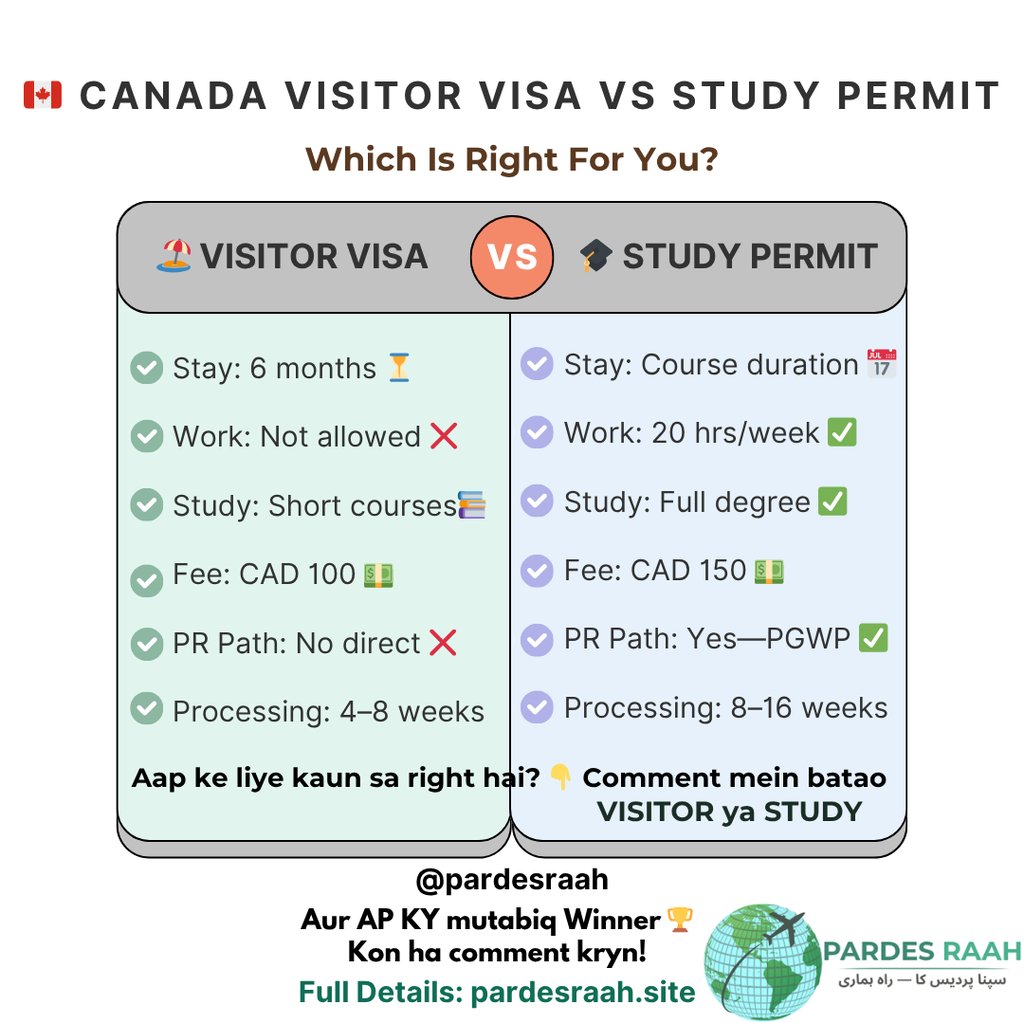
A Canada Visitor Visa allows a maximum stay of 6 months per entry. After 6 months the visitor must either leave Canada or apply for an extension before their status expires. Extensions are not guaranteed and are assessed case by case. Repeated extensions without a clear and genuine purpose raise concerns with IRCC about the visitor's true intentions.
A Canada Study Permit is valid for the entire duration of your enrolled academic program. A 4-year bachelor's degree means 4 years of authorised stay. A 2-year master's program means 2 full years in Canada. After completing the program the study permit remains valid for an additional 90 days during which graduates can apply for the PGWP. For Pakistani students with long-term settlement goals, the study permit provides a structured and legally secure multi-year stay that the visitor visa cannot offer.
Work Rights:
A Canada Visitor Visa holder is strictly prohibited from working in Canada in any capacity with very limited exceptions. Any visitor found working without authorisation faces serious immigration consequences including removal from Canada and a potential ban on future applications.
A Canada Study Permit holder has clear and legally recognised work rights. During the academic term, study permit holders can work up to 20 hours per week off campus. During official university breaks such as summer and winter holidays, they can work full-time with no hourly restriction. This allows Pakistani students to earn income to offset living costs and tuition fees while building Canadian work experience that strengthens their future PR application. The average part-time wage in Canada ranges from CAD 16 to CAD 20 per hour depending on the province and type of work, meaning a Pakistani student working 20 hours per week can earn CAD 1,280 to CAD 1,600 per month toward their expenses.
Study Rights:
A Canada Visitor Visa permits participation only in programs of 6 months or less. This is suitable for short English language courses or professional workshops but does not allow enrollment in full degree programs. Pakistani applicants wanting to complete a bachelor's, master's, or PhD degree in Canada must have a study permit — a visitor visa is simply not sufficient for this purpose.
A Canada Study Permit allows full enrollment in any program at a Designated Learning Institution. This includes undergraduate degrees, postgraduate diplomas, master's degrees, doctoral programs, and vocational training certificates. The full range of Canadian educational credentials is accessible only through the study permit pathway.
PR Pathway:
For Pakistani families whose ultimate goal is Canadian Permanent Residency — which represents the majority of Pakistani applicants — the PR pathway comparison between the two options is the most decisive factor.
A Canada Visitor Visa offers no direct pathway to Permanent Residency. While it is theoretically possible to apply for certain immigration streams from within Canada on a visitor visa, this is complex, uncertain, and not a reliable strategy for most Pakistani applicants.
A Canada Study Permit is one of the most proven and structured PR pathways available to Pakistanis in 2026. After completing a Canadian degree or diploma of at least 8 months duration at a DLI, graduates are eligible to apply for the Post-Graduation Work Permit. The PGWP allows Canadian graduates to work for any employer in Canada for 1 to 3 years depending on the length of their program. During the PGWP period Pakistani graduates build Canadian work experience which earns Comprehensive Ranking System points under Express Entry. With sufficient CRS points and Canadian work experience, Pakistani graduates can receive an Invitation to Apply for Permanent Residency through Express Entry — typically within 2 to 4 years of completing their Canadian degree. This study-to-PR pipeline is one of the most reliable immigration pathways available to Pakistanis today.
Fees:
The Canada Visitor Visa application fee is CAD 100 per adult applicant, which is approximately PKR 21,000 at current exchange rates. For a family application the combined visitor visa fee is capped at CAD 500.
The Canada Study Permit application fee is CAD 150 per applicant, which is approximately PKR 31,500. Both fees are non-refundable regardless of whether the application is approved or rejected. Pakistani applicants must also budget for biometrics fees of CAD 85 per person which applies to both visitor visa and study permit applications submitted from Pakistan. Study permit applicants must additionally budget for Canadian institution tuition fees, living costs in Canada, and the full cost of obtaining and attesting all required documents in Pakistan before applying.
Processing Time:
Canada Visitor Visa processing time for Pakistani applicants currently ranges from 4 to 8 weeks after complete application submission. During peak periods such as summer months processing can occasionally extend beyond 8 weeks.
Canada Study Permit processing time for Pakistani applicants is significantly longer and currently ranges from 8 to 16 weeks after complete application submission. IRCC also offers the Student Direct Stream, known as SDS, for eligible Pakistani applicants which targets processing within 20 calendar days provided specific requirements are met including a Guaranteed Investment Certificate, upfront medical exam, and IELTS score of 6.0 or above. Pakistani students planning to begin a September semester should ideally submit their study permit application by April or May at the latest to allow sufficient processing time.
Documents Required:
For the Canada Visitor Visa, Pakistani applicants need a valid passport, completed online application form, recent photographs, proof of financial funds sufficient for the trip and return to Pakistan, a detailed travel itinerary, a letter of invitation if visiting family, employment or business documentation showing strong ties to Pakistan, and CAD 100 fee payment. Applications are submitted through the IRCC online portal at canada.ca/en/immigration-refugees-citizenship.
For the Canada Study Permit, Pakistani applicants need a valid passport, a letter of acceptance from a Canadian Designated Learning Institution, proof of financial funds showing at least CAD 10,000 for living expenses for the first year plus full tuition fees, IELTS or equivalent English language test results with a minimum overall score of 6.0, a completed online application form, a detailed statement of purpose explaining why you want to study in Canada and your future plans, educational transcripts and degree certificates attested from Pakistan, and CAD 150 fee payment. Applications are submitted through the IRCC portal at canada.ca. Pakistani students applying through the Student Direct Stream must additionally provide a Guaranteed Investment Certificate from a participating Canadian financial institution.
Important Tips:
Pakistani applicants who apply for a visitor visa with the hidden intention of converting to a study permit or staying beyond 6 months must be extremely careful — misrepresentation of intentions on a Canadian visa application is a serious offence that can result in a multi-year application ban. If your real goal is to study in Canada, apply for a study permit from the beginning rather than attempting a conversion from inside Canada. For study permit applicants, choose your Canadian institution carefully — only programs at Designated Learning Institutions qualify for study permits and PGWP eligibility. Check the official DLI list at canada.ca before applying. Pakistani students should also research provincial nominee programs as several Canadian provinces have specific streams designed to attract and retain international graduates, which can significantly accelerate the PR process after graduation.
Conclusion:
The choice between a Canada Visitor Visa and a Canada Study Permit depends entirely on what you want from Canada. If your goal is a short family visit, a brief experience of the country, or attendance at a short course — the visitor visa is the right answer. If your goal is a full Canadian degree, the ability to work while studying, and a clear structured pathway to Permanent Residency — the study permit is not just the better choice, it is the only choice. In 2026, thousands of Pakistani students are already walking the study-to-PR path in Canada successfully. With the right institution, the right program, and the right preparation, your Canadian dream is not just possible — it is achievable step by step.
For free visa guides, document checklists, and daily immigration updates made for Pakistani applicants follow PardesRaah on YouTube, Instagram, Facebook, TikTok and X.
سپنا پردیس کا — راہ ہماری ✈️🌍
© PardesRaah — Pakistan's #1 Visa & Immigration Media Hub
Sapna Pardes Ka — Raah Humari
Pakistan's free daily visa and immigration information hub.
Har roz naye guides — bilkul free.
Quick Links
Visa Categories
Popular Countries
© 2026 PardesRaah. All rights reserved.
Disclaimer: All information on PardesRaah is for educational purposes only. We are not immigration lawyers or consultants.