7 Embassy Checks for Schengen Visa Approval
PardesRaah
5/17/20268 min read
Europe ka darwaza band nahi — bas sahi cheezein sahi jagah honi chahiye.
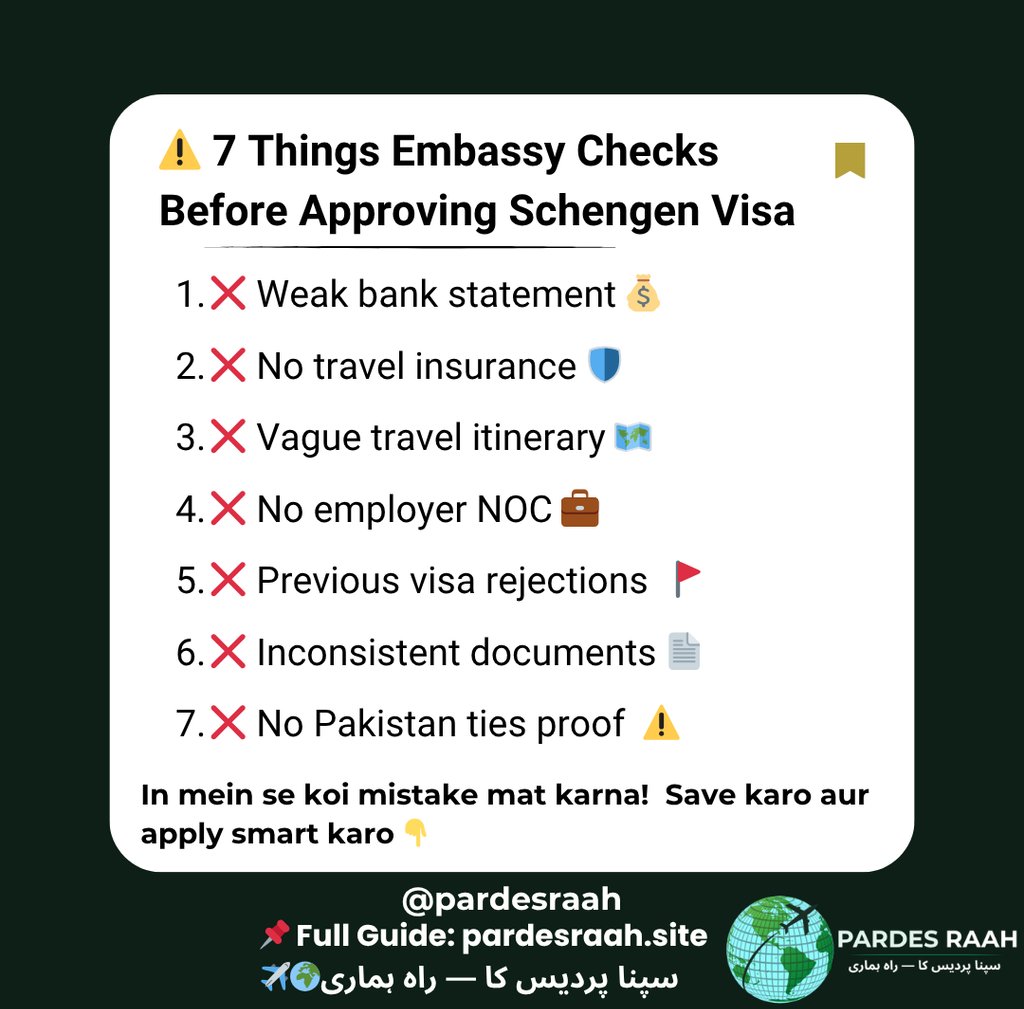
7 Things Embassy Checks Before Approving Your Schengen Visa
Introduction:
Every year thousands of Pakistani passport holders apply for a Schengen visa with the dream of visiting Europe — and every year a significant number of those applications are rejected. The most frustrating part is that many rejections happen not because the applicant was unqualified but because they did not know exactly what the embassy looks for when reviewing a Pakistani Schengen visa application. A Schengen visa officer does not just glance at your documents — they conduct a structured and systematic review of your entire application file against a specific checklist of criteria. In 2026, knowing exactly what that checklist contains gives Pakistani applicants a genuine and powerful advantage. This guide reveals all 7 things embassy checks before approving your Schengen visa and exactly how to make sure every single one works in your favour.
What Is a Schengen Visa and Why Is It Hard for Pakistanis?
A Schengen visa is a short-stay visa that allows travel across 27 European countries for up to 90 days within any 180-day period. For Pakistani passport holders, it is one of the most valuable and most difficult visas to obtain. Pakistan's passport ranking, limited bilateral travel history with Europe, and concerns about overstaying have historically led to higher scrutiny of Pakistani applications compared to applicants from stronger passport countries. This does not mean approval is impossible — it means Pakistani applicants must prepare stronger and more detailed applications than applicants from countries with easier visa relationships with Europe.
Thing 1: Bank Statement and Financial Proof
The bank statement is the first and most heavily scrutinised document in any Pakistani Schengen visa application. Embassy visa officers look for three specific things in your bank statement. They look at the balance level, the consistency of that balance over time, and the source of the funds. The standard Schengen financial requirement is a minimum of €50 per day of your planned stay in Europe. For a 15-day trip this means €750 minimum. For a 30-day trip this means €1,500 minimum. However Pakistani applicants are strongly advised to show significantly more than the bare minimum — a balance of €2,000 to €3,000 for a 15-day trip is far more convincing than exactly €750.
The consistency of your balance matters enormously. A bank statement showing a steady balance maintained over 3 to 6 months demonstrates genuine financial stability. A statement showing a large sudden deposit made 1 or 2 weeks before your application is submitted is a major red flag for visa officers — it strongly suggests the funds were borrowed specifically for the visa application and do not represent your actual financial situation. Your bank statement must be printed on official bank letterhead, stamped, and signed by an authorised bank officer. Statements printed from internet banking without an official stamp are not accepted by most Schengen embassies.
Thing 2: Travel Insurance
Travel insurance is a non-negotiable mandatory requirement for every Schengen visa application without exception. There is no flexibility on this point — an application submitted without valid travel insurance that meets Schengen requirements will be rejected automatically without any consideration of the other documents. The insurance must provide a minimum medical coverage of €30,000, must be valid in all 27 Schengen countries, and must cover the entire duration of your planned stay in Europe including travel days.
Pakistani applicants can purchase Schengen-compliant travel insurance from international providers online. The policy document must explicitly state that it meets Schengen visa requirements — generic travel insurance policies that do not mention this specifically may not be accepted. The cost of a compliant 15 to 30 day Schengen travel insurance policy is typically between PKR 6,000 and PKR 15,000 depending on the provider and coverage level. Always purchase travel insurance before submitting your visa application — not after.
Thing 3: Travel Itinerary
A vague or generic travel itinerary is one of the most common reasons for Schengen visa rejection among Pakistani applicants and one of the most easily preventable. Embassy visa officers look for a detailed, realistic, and logically structured travel plan that demonstrates you have genuinely planned your trip and have clear reasons for visiting Europe. A travel itinerary that simply says "visiting Europe for tourism" with no specific details immediately creates suspicion about the true purpose of the visit.
Your travel itinerary must include the specific countries and cities you plan to visit, the dates of arrival and departure in each location, your accommodation for each night of your stay with confirmed hotel booking references, the specific attractions, activities, or events you plan to attend, and a clear logical flow that makes geographical sense. If you plan to visit multiple Schengen countries your itinerary must show how you will travel between them and confirm that your primary destination justifies applying through the country whose embassy you are using. A well-prepared day-by-day itinerary that shows genuine planning significantly strengthens your application and demonstrates to the visa officer that you have a real, purposeful trip planned.
Thing 4: Employer NOC and Employment Proof
The No Objection Certificate from your employer is a critical document for Pakistani Schengen visa applicants that demonstrates your employment status and your intention to return to Pakistan after your trip. Embassy visa officers use employment proof to assess your ties to Pakistan — a person with stable employment who has approved leave from their employer is far less likely to overstay their Schengen visa than an unemployed person with no professional obligations at home.
Your NOC must be on official company letterhead, signed by an authorised company representative, state your name, designation, salary, and length of employment, confirm the exact dates of your approved leave, and state clearly that the company has no objection to your travel to Europe. It must also state that your position and employment will be maintained upon your return. Along with the NOC, include your most recent 3 months of salary slips and your employment contract to provide a complete and consistent picture of your professional situation. Self-employed Pakistani applicants should provide their business registration documents, bank statements showing business income, and a personal declaration letter explaining their business and their intention to return to manage it.
Thing 5: Previous Visa Rejections
Every Schengen visa application form asks applicants to declare any previous visa rejections. This question must be answered honestly and completely — attempting to conceal a previous rejection is a serious form of fraud that can result in a permanent ban from the Schengen area. Pakistani applicants who have previously been rejected for a Schengen visa must declare this on every subsequent application and provide a brief explanation of the circumstances.
A previous rejection does not automatically mean your new application will also be rejected. What matters is whether you have addressed the reason for the previous rejection in your new application. If your first application was rejected due to insufficient financial proof and your new application shows a strong and consistent bank balance, the previous rejection becomes much less significant. Include a cover letter with your new application that acknowledges the previous rejection, explains what has changed since then, and demonstrates how your new application addresses all the concerns that led to the original refusal. Visa officers appreciate transparency and a clear demonstration of having rectified previous weaknesses.
Thing 6: Document Consistency
Embassy visa officers are trained to cross-check every document in your application against every other document to identify any inconsistencies. Your salary slip must match your bank statement deposits. Your employment letter must match your NOC. Your stated income must be consistent with your claimed financial situation. Your accommodation bookings must match your travel itinerary dates. Your passport details must match your application form exactly. Any inconsistency — even a small one — immediately raises doubts about the authenticity of your documents and can lead to rejection or a request for additional supporting evidence.
Before submitting your Schengen visa application, go through every document in your file and cross-check them against each other. Make sure names are spelled consistently across all documents, dates match throughout the file, financial figures are consistent, and every claim you make in your application is supported by at least one document in your file. A consistent, coherent, and mutually supporting document file is one of the strongest signals you can send to a visa officer that your application is genuine and trustworthy.
Thing 7: Proof of Strong Ties to Pakistan
This is the single most important factor in any Pakistani Schengen visa application and the one that embassy visa officers give the greatest weight to. The fundamental question a Schengen visa officer asks about every Pakistani application is: will this person return to Pakistan at the end of their authorised stay? The presence of strong, documented ties to Pakistan is the most powerful evidence you can provide that the answer to this question is yes.
Strong ties to Pakistan that visa officers recognise include stable employment with a confirmed position to return to, ownership of property in Pakistan whether a home, land, or commercial property, immediate family members in Pakistan including spouse, children, or dependent parents, ongoing financial commitments such as a home loan, car finance, or business obligations, and any other personal, professional, or financial situation that gives you a compelling reason to return. These ties must be documented — employment letters, property ownership papers, marriage certificate, children's birth certificates, and loan statements are all examples of documents that prove your ties to Pakistan. Pakistani applicants who provide clear and strong ties documentation give themselves the best possible chance of Schengen visa approval regardless of their passport strength.
Fees and Costs:
The Schengen visa fee is €90 per adult applicant, which is approximately PKR 28,000 at current exchange rates. This fee is non-refundable. Schengen travel insurance costs approximately PKR 6,000 to PKR 15,000 for a standard policy. VFS Global service charges for visa submission assistance are approximately PKR 3,500 to PKR 5,000. Document preparation costs including bank statement printing, photographs, and any notarisation or translation fees add approximately PKR 3,000 to PKR 8,000 to the total cost. The complete cost of a well-prepared Schengen visa application for a Pakistani applicant is typically between PKR 40,000 and PKR 55,000 including all fees and document costs.
Processing Time:
Schengen visa applications are processed within 15 working days as required under Schengen regulations. Applications submitted with complete and consistent documentation are often processed faster. Incomplete applications or those requiring additional document requests take longer and may use the full 15 working days or beyond in some cases. Pakistani applicants are advised to submit their Schengen visa applications at least 4 to 6 weeks before their planned travel date to allow sufficient time for processing and to address any additional document requests from the embassy.
Important Tips:
Always submit your Schengen visa application with a well-written personal cover letter that introduces yourself, explains your travel purpose, describes your ties to Pakistan, and addresses any weaknesses in your application proactively. Never submit a rushed or incomplete application just to meet a deadline — a rejected application costs you the €90 fee, leaves a rejection record on your file, and delays your travel plans by months. If possible, include evidence of previous successful international travel in your application — even travel to Turkey, Malaysia, UAE, or other countries demonstrates a track record of responsible travel and visa compliance. Organise your entire document file in a clean and logical order before submission — a well-organised file creates a positive first impression and makes the visa officer's review easier and faster.
Conclusion:
Getting a Schengen visa approved as a Pakistani passport holder in 2026 is absolutely achievable — but it requires understanding exactly what the embassy is looking for and preparing your application accordingly. A strong bank statement maintained consistently over months, valid travel insurance, a detailed day-by-day itinerary, a proper employer NOC, honest declaration of any previous rejections, perfectly consistent documents, and compelling proof of your ties to Pakistan together form an application that gives the visa officer every reason to approve your visa. Knowledge is your greatest advantage — use it, prepare thoroughly, and make your Europe dream a reality.
For free visa guides, document checklists, and daily immigration updates made for Pakistani applicants follow PardesRaah on YouTube, Instagram, Facebook, TikTok and X.
سپنا پردیس کا — راہ ہماری ✈️🌍
© PardesRaah — Pakistan's #1 Visa & Immigration Media Hub


Sapna Pardes Ka — Raah Humari
Pakistan's free daily visa and immigration information hub.
Har roz naye guides — bilkul free.
Quick Links
Visa Categories
Popular Countries
© 2026 PardesRaah. All rights reserved.
Disclaimer: All information on PardesRaah is for educational purposes only. We are not immigration lawyers or consultants.