Germany New Immigration Law 2026 for Pakistani Applicants
PardesRaah
5/10/20267 min read
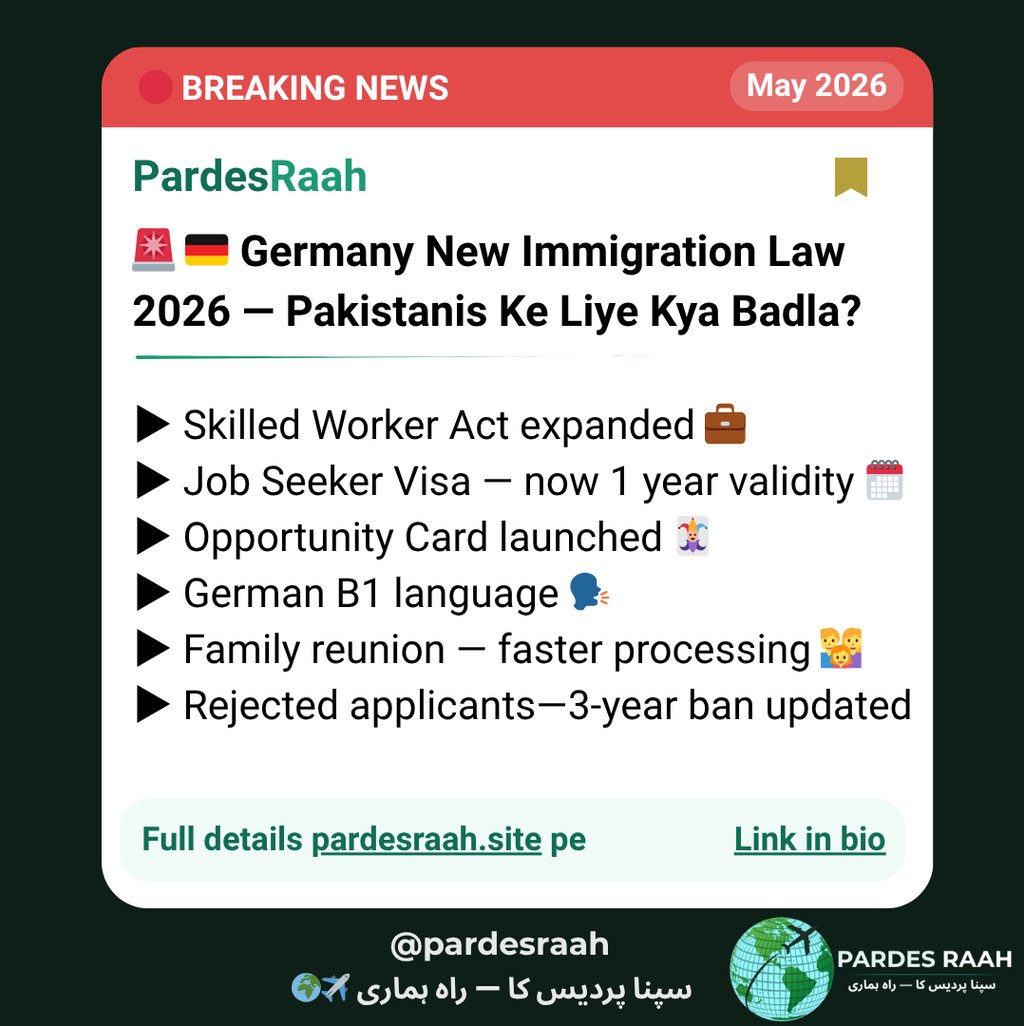
Germany ka darwaza 2026 mein aur khula hai — bas jaanna chahiye ke kaise daakhil hona hai.
Germany New Immigration Law 2026 — How It Affects Pakistani Applicants
Introduction:
Germany has always been one of the most attractive immigration destinations for skilled Pakistani professionals. But 2026 has brought a wave of significant changes to German immigration law that every Pakistani applicant must understand before applying. From the extension of the Job Seeker Visa to the launch of the brand new Opportunity Card, and from stricter German language requirements for PR to faster family reunion processing — these changes affect every stage of the immigration journey. This guide explains every major update in Germany's new immigration law and exactly what it means for Pakistani applicants in 2026.
Why Did Germany Change Its Immigration Law?
Germany is currently facing a severe shortage of skilled workers across multiple sectors. According to the German government, there is a shortage of over 400,000 skilled professionals in fields including IT, engineering, healthcare, construction, and logistics. To address this crisis, Germany has updated its immigration framework to make it easier and faster for qualified professionals from countries like Pakistan to enter, work, and settle in Germany. These changes are not just administrative updates — they represent a fundamental shift in how Germany views and welcomes international talent.
Who Is Affected by These Changes?
These new immigration law changes affect a wide range of Pakistani applicants. Pakistani professionals planning to apply for the Job Seeker Visa will benefit from the extended validity period. Skilled workers who previously had no pathway due to missing job offers can now explore the Opportunity Card. Pakistani families waiting for reunion with their relatives in Germany will experience faster processing. Those already living in Germany on work permits need to be aware of the updated PR language requirements. And Pakistani applicants who have previously been rejected need to understand the updated ban rules before reapplying.
Change 1: Job Seeker Visa Extended to 1 Year
This is one of the most significant and directly beneficial changes for Pakistani applicants. Previously, the Germany Job Seeker Visa was valid for 6 months — giving applicants half a year to find a job in Germany in person. Under the new 2026 immigration law, the Job Seeker Visa has been extended to 1 year for qualifying applicants.
This change is enormously important for Pakistani professionals who previously felt that 6 months was not enough time to properly search for a job, attend interviews, complete background checks, and go through the hiring process in an unfamiliar country. With 12 months now available, Pakistani applicants have double the time to explore job opportunities, build professional networks, attend interviews, and secure the right position. The eligibility requirements remain the same — a recognised degree, relevant work experience, sufficient funds, and a strong motivation letter — but applicants now have significantly more time to make their Germany dream a reality.
Change 2: The Opportunity Card — Germany's New Points-Based Entry
The Opportunity Card, known in German as the Chancenkarte, is a completely new immigration pathway launched under Germany's updated immigration law. It is a points-based system that allows skilled professionals to enter Germany to look for work — even without a recognised degree or a confirmed job offer, provided they score enough points under the system.
Points are awarded based on four main criteria. Your professional qualifications and whether they are recognised in Germany contribute points to your score. Your work experience in your relevant field is also awarded points. Your age plays a role — younger applicants typically score higher. Your German language skills are also assessed for points. English language skills can also earn limited points under the new system.
For Pakistani applicants, the Opportunity Card opens a completely new door that did not exist before. Previously, Pakistani professionals without a German-recognised degree had virtually no pathway to enter Germany legally for job searching purposes. The Opportunity Card changes this fundamentally. To apply, you need to score the minimum required points and show financial proof of at least €1,027 per month for your planned stay. Full eligibility details and the points calculator are available at make-it-in-germany.com.
Change 3: B1 German Language Now Mandatory for PR
This change represents a tightening of the PR requirements that Pakistani applicants already in Germany or planning to settle there must take very seriously. Under the previous rules, applicants could achieve Permanent Residency in Germany with A2 level German language proficiency in some circumstances. Under the new 2026 immigration law, B1 level German is now the minimum mandatory requirement for all PR applications.
The difference between A2 and B1 is significant. A2 represents basic conversational ability while B1 represents intermediate proficiency — the ability to understand and communicate on familiar topics in a clear and connected manner. For Pakistani professionals planning to make Germany their permanent home, this means German language learning is no longer optional. It is a legal requirement that must be met before PR can be granted. Pakistani applicants are strongly advised to begin German language classes immediately, even before applying for their visa. German language courses are available in Pakistan through the Goethe Institut at goethe.de/pakistan and through various private institutes in Karachi, Lahore, and Islamabad.
Change 4: Family Reunion Processing Now Faster
For the thousands of Pakistani professionals already living and working in Germany, one of the most emotionally important changes in the new law is the significant reduction in family reunion processing times. Under the previous system, family reunion visa applications from Pakistan were taking up to 6 months or longer to be processed — leaving families separated for extended periods.
Under the new 2026 immigration law, Germany has committed to processing family reunion visa applications within 3 months. This is a 50 percent reduction in processing time and represents a major quality of life improvement for Pakistani workers in Germany who have been separated from their spouses, children, and parents. To benefit from this faster processing, the sponsoring family member in Germany must have a valid residence permit, sufficient income to support the family, and adequate housing. The family reunion visa application is submitted at the German Embassy in Islamabad through pakistan.diplo.de.
Change 5: Skilled Worker Act — More Sectors Now Open
Germany's updated Skilled Worker Act, which was first introduced in 2023, has been further expanded in 2026 to include additional sectors and occupational categories. Under the expanded act, Pakistani professionals in fields including IT, software development, cybersecurity, nursing, elder care, mechanical engineering, electrical engineering, civil engineering, and logistics can now qualify for German work visas even if their specific degree title does not have a direct German equivalent — provided they can demonstrate relevant professional experience.
This is a major change for Pakistani applicants whose degrees may have been rejected in the past due to partial recognition issues. The expanded Skilled Worker Act gives greater flexibility in how qualifications are assessed and recognised. Pakistani applicants can check whether their specific occupation is covered under the expanded act using the official recognition database at anerkennung-in-deutschland.de.
Change 6: Updated Rules for Previously Rejected Applicants
Under Germany's previous immigration rules, applicants who were rejected could face a re-entry or reapplication ban of varying lengths depending on the reason for rejection. The new 2026 law has clarified and standardised this process. Applicants who were rejected due to incomplete documents or insufficient funds now face a 3-year period before they can reapply for the same visa category.
However, the new law also introduces an important exception. If a previously rejected applicant can demonstrate that the reason for their rejection has been fully resolved — for example by completing the required attestation, building sufficient funds, or improving language skills — they may be able to request an early review of their case in some circumstances. Pakistani applicants who have previously been rejected are strongly advised to consult the German Embassy directly at pakistan.diplo.de before reapplying to understand exactly which rules apply to their specific case.
Fees and Costs Under the New Law:
The Germany national visa application fee remains €75, which is approximately PKR 23,000. The new Opportunity Card application fee is also €75. Family reunion visa fees are €75 per adult applicant. German language course fees in Pakistan range from PKR 15,000 to PKR 50,000 per level depending on the institute and format. Goethe Institut Pakistan offers certified German language courses with internationally recognised certificates that are accepted by the German Embassy. Document attestation costs remain the same as previously outlined — HEC attestation at PKR 1,000 to PKR 3,000 per document and MOFA attestation at approximately PKR 1,000 per document.
Processing Times Under the New Law:
Job Seeker Visa processing after appointment at the German Embassy in Islamabad currently takes 6 to 12 weeks. Opportunity Card processing takes approximately 8 to 12 weeks. Family reunion visa processing under the new law is targeted at 3 months from the date of complete application submission. Skilled worker visa processing after a confirmed job offer takes approximately 4 to 8 weeks. All processing times assume complete and correctly attested document submissions — incomplete applications will cause delays regardless of the new law's targets.
Important Tips:
Start your German language classes immediately — B1 is now a PR requirement and reaching that level takes most Pakistani learners 12 to 18 months of consistent study. Use the Opportunity Card points calculator at make-it-in-germany.com to check your eligibility before starting the full application process. If you are already in Germany on a work permit, check your current German language level against the new B1 PR requirement and plan accordingly. For family reunion applications, make sure your German residence status and income meet the new 2026 requirements before submitting — incomplete sponsorship information is the most common cause of family reunion delays. Always apply through official German Embassy channels at pakistan.diplo.de and avoid paying agents for services you can complete yourself through official portals.
Conclusion:
Germany's new immigration law in 2026 is genuinely good news for skilled Pakistani professionals. The extended Job Seeker Visa, the brand new Opportunity Card, faster family reunion processing, and the expanded Skilled Worker Act all represent real and meaningful improvements that open more doors for Pakistani applicants than ever before. The key change to prepare for is the B1 German language requirement for PR — start working on this now if you have not already. With the right preparation, the right documents, and the right language skills, Germany in 2026 is more accessible for Pakistanis than at any point in recent history.
For free visa guides, document checklists, and daily immigration updates made for Pakistani applicants follow PardesRaah on YouTube, Instagram, Facebook, TikTok and X.
سپنا پردیس کا — راہ ہماری ✈️🌍
© PardesRaah — Pakistan's #1 Visa & Immigration Media Hub
Sapna Pardes Ka — Raah Humari
Pakistan's free daily visa and immigration information hub.
Har roz naye guides — bilkul free.
Quick Links
Visa Categories
Popular Countries
© 2026 PardesRaah. All rights reserved.
Disclaimer: All information on PardesRaah is for educational purposes only. We are not immigration lawyers or consultants.