Hajj Visa vs Umrah Visa: A 2026 Guide for Pakistanis
PardesRaah
5/20/20269 min read
Baitullah ke saamne sajda karna — chahe Hajj ho ya Umrah — har Pakistani Muslim ka sabse bada sapna hai.
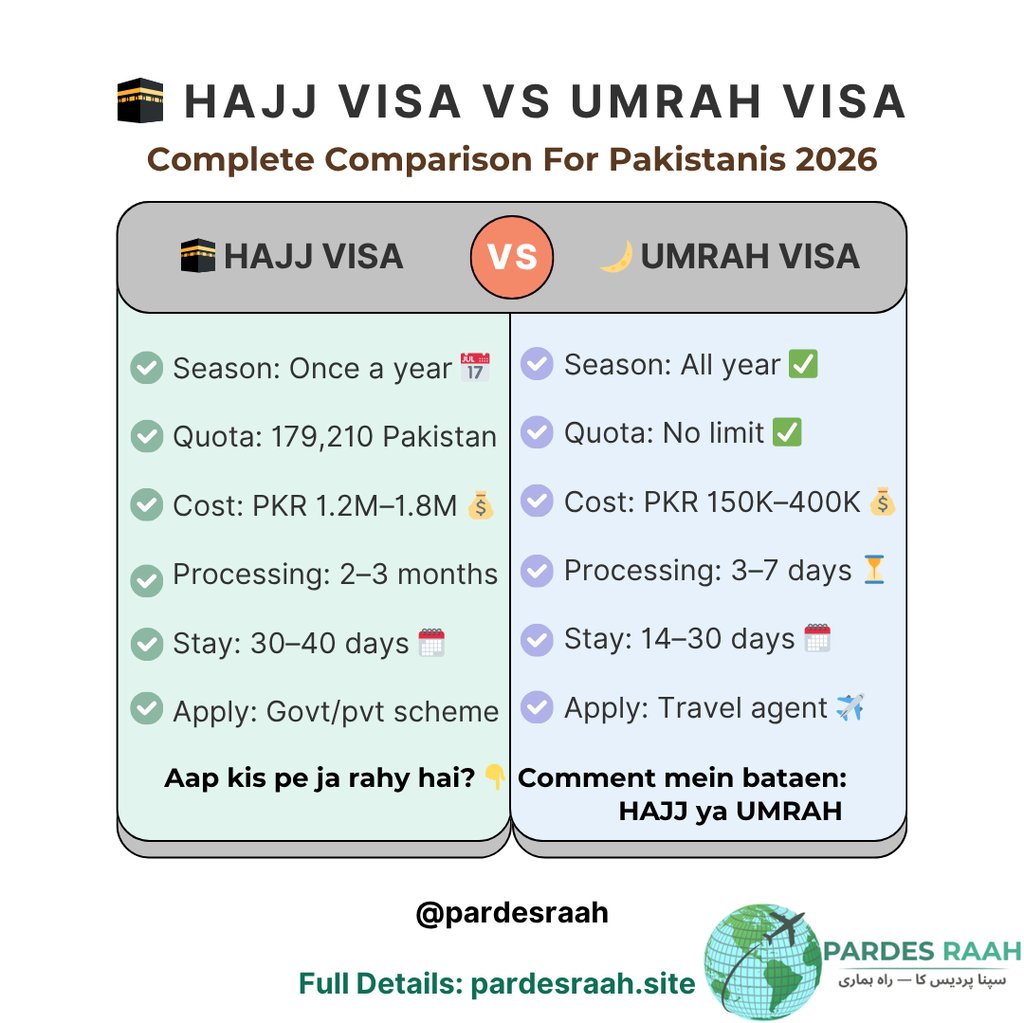
Hajj Visa vs Umrah Visa — Complete Comparison For Pakistanis
Introduction:
For every Pakistani Muslim, the journey to the holy cities of Mecca and Medina is the most sacred and emotionally significant travel experience of their lifetime. Whether it is the obligatory pilgrimage of Hajj or the deeply spiritual voluntary journey of Umrah — both represent a profound connection between a Pakistani Muslim and their faith that no other travel experience can match. But many Pakistani families planning their sacred journey are confused about the key differences between the Hajj Visa and the Umrah Visa — their costs, their processes, their timelines, and their requirements. In 2026, this guide gives Pakistani Muslims a complete, clear, and honest comparison of both visa types so you can plan your blessed journey with full knowledge and complete confidence.
What Is the Hajj Visa?
The Hajj Visa is a special category of Saudi Arabian visa issued exclusively to Muslim pilgrims intending to perform the annual Hajj pilgrimage in Mecca. Hajj is one of the five pillars of Islam and is obligatory once in a lifetime for every Muslim who is physically and financially able. The Hajj pilgrimage takes place during the Islamic month of Dhul Hijjah and in 2026 falls in the latter part of the year. The Hajj Visa is issued only during the Hajj season and Pakistani Muslims can only obtain it through the official Government Hajj Scheme managed by the Ministry of Religious Affairs at mora.gov.pk or through a licensed private Hajj tour operator approved by the Ministry. The Hajj Visa cannot be obtained independently and is tied exclusively to the official Hajj management system.
What Is the Umrah Visa?
The Umrah Visa is a Saudi Arabian visa that allows Muslims to perform Umrah — the lesser or voluntary pilgrimage — at any time of the year. Unlike Hajj which is obligatory and seasonal, Umrah is a voluntary act of worship that can be performed at any point throughout the year including during Ramadan, which is considered the most spiritually rewarding time for Umrah. The Umrah Visa is processed through registered Pakistani travel agents who are licensed to operate Umrah packages. Pakistani Muslims do not need to go through any government scheme or quota system for Umrah — any registered travel agent can arrange the visa, flights, and accommodation in a single package.
Who Should Read This Guide?
This guide is for Pakistani Muslim families and individuals who are planning to visit the holy cities in 2026 and need to understand the clear and practical differences between the Hajj Visa and the Umrah Visa. It is particularly useful for families deciding whether to apply for Hajj this year or perform Umrah in the meantime, and for first-time pilgrims who are unfamiliar with the processes, costs, and timelines involved in each option.
Season and Availability:
The most fundamental difference between the Hajj Visa and the Umrah Visa is when they are available.
The Hajj Visa is available only once a year during the Hajj season which falls in the Islamic month of Dhul Hijjah. Outside this annual window it is simply not possible to perform Hajj — the rituals of Hajj are tied to specific dates and locations that only occur during this sacred period each year. Pakistani Muslims who miss the Hajj season must wait until the following year to apply again.
The Umrah Visa, by contrast, is available throughout the entire year with no seasonal restriction. Pakistani Muslims can perform Umrah in any month they choose — in the blessed month of Ramadan for maximum spiritual reward, during school holidays for family convenience, in winter months when the weather in Mecca and Medina is cooler and more comfortable, or at any other time that suits their schedule and budget. This year-round availability makes Umrah far more accessible and flexible for Pakistani families than Hajj.
Quota System:
Pakistan's confirmed Hajj quota for 2026 is 179,210 pilgrims. This quota is allocated by the Saudi government to Pakistan and is divided between the Government Hajj Scheme and the Private Hajj Scheme. Because the quota is limited relative to the enormous number of Pakistani Muslims who wish to perform Hajj every year, the government uses a computerised balloting system to select applicants when applications exceed available seats in a particular scheme. This means many Pakistani Muslims who apply for Hajj in a given year are not selected and must wait for future years. The waiting list for Hajj in some parts of Pakistan can be several years long depending on the province and scheme.
The Umrah Visa has no quota system whatsoever. There is no limit on the number of Pakistani Muslims who can perform Umrah in any given year and there is no waiting list, no balloting, and no government allocation process. Any Pakistani Muslim who meets the basic requirements and can afford the package cost can perform Umrah at any time they choose. This absence of any quota or restriction makes Umrah the most immediately accessible sacred journey for Pakistani Muslims in 2026.
Cost Comparison:
The cost difference between Hajj and Umrah is one of the most significant practical differences for Pakistani families planning their sacred journey.
The Hajj package cost for Pakistani pilgrims in 2026 ranges from PKR 1.2 million to PKR 1.8 million per person depending on the scheme and accommodation category. The Government Hajj Scheme offers packages starting from approximately PKR 1.2 million per person for standard accommodation. Private Hajj Scheme packages range from PKR 1.5 million to PKR 1.8 million per person and typically include better accommodation closer to Masjid al-Haram and more personalised service. For a Pakistani husband and wife performing Hajj together, the combined cost ranges from PKR 2.4 million to PKR 3.6 million.
The Umrah package cost for Pakistani pilgrims in 2026 is significantly more affordable and ranges from PKR 150,000 to PKR 400,000 per person depending on the season, the hotel category, the proximity to Masjid al-Haram, and the specific package inclusions. Budget Umrah packages during the quieter months of the Islamic year can be found for approximately PKR 150,000 to PKR 200,000 per person. Premium Ramadan Umrah packages — which are the most sought-after and the most expensive — can range from PKR 300,000 to PKR 400,000 or more per person due to the extraordinarily high demand during the holy month. For a Pakistani couple performing Umrah together on a mid-range package, the combined cost typically ranges from PKR 300,000 to PKR 600,000.
Processing Time:
The Hajj Visa process is considerably longer and more complex than the Umrah Visa process due to the government coordination, quota allocation, and official scheme management involved. The complete Hajj application process from initial registration to visa confirmation typically takes 2 to 3 months for Pakistani applicants. This timeline includes registering with the Government Hajj Scheme or a licensed private operator, completing the document submission and verification process, going through balloting if applicable, receiving official confirmation of selection, completing health vaccinations, and receiving the visa in the passport before departure.
The Umrah Visa process is dramatically faster. A registered Pakistani travel agent can typically obtain an approved Umrah Visa for their client within 3 to 7 working days after submitting the required documents. During peak Umrah seasons such as Ramadan, processing times can occasionally extend to 10 to 14 days due to high demand, but the process remains far quicker than Hajj in all circumstances. This fast processing makes Umrah a practical option even for Pakistani families who decide to travel with relatively short notice.
Stay Duration:
Pakistani Hajj pilgrims typically stay in Saudi Arabia for 30 to 40 days during the Hajj season. This extended stay is necessary to perform all the Hajj rituals which span several days across multiple locations including Mecca, Mina, Muzdalifah, and Arafat, as well as to allow time for Ziyarat visits to the Prophet's Mosque in Medina before or after Hajj. The Hajj Visa is a single-entry visa that covers only this designated Hajj period.
Pakistani Umrah pilgrims typically stay in Saudi Arabia for 14 to 30 days depending on the package chosen. Shorter Umrah packages of 14 to 15 days are designed for pilgrims who want to perform Umrah efficiently and return home. Longer packages of 21 to 30 days allow more time for worship, reflection, and Ziyarat visits to historical and religious sites in both Mecca and Medina. The Umrah Visa is currently issued as a multiple-entry visa for Pakistani passport holders which means pilgrims can in some cases make more than one trip to Saudi Arabia on the same visa subject to the visa's validity period.
Application Process:
The Hajj Visa application process for Pakistani Muslims is structured and government-managed. Pakistani Muslims must register through the official Government Hajj Scheme at mora.gov.pk or with a Ministry-approved private Hajj tour operator. Required documents include a valid passport with at least 6 months validity, a CNIC, recent passport size photographs, a completed Hajj application form, a meningitis vaccination certificate, and a polio vaccination certificate. Fee payment must be made through designated banks listed on the Ministry of Religious Affairs website. The entire process is managed collectively by the Ministry in coordination with the Saudi Hajj authorities and individual applicants do not interact directly with the Saudi Embassy for Hajj purposes.
The Umrah Visa application process is handled entirely by registered Pakistani travel agents. The required documents are a valid passport with at least 6 months validity, a recent passport size photograph with white background, a meningitis vaccination certificate which is mandatory for all Saudi Arabia visitors, a CNIC copy, and the Umrah package booking confirmation from the travel agent. The travel agent submits these documents to the Saudi Embassy or through the official Nusuk platform at nusuk.sa on behalf of the pilgrim. Pakistani Muslims must ensure their Umrah travel agent is officially registered and licensed — a list of approved operators is available through the Ministry of Religious Affairs at mora.gov.pk.
Mandatory Vaccinations:
Both the Hajj Visa and the Umrah Visa require a meningitis vaccination certificate as a mandatory health requirement for entry into Saudi Arabia. The meningitis vaccination must be received at least 10 days before departure and the certificate must be from a recognised health authority. The vaccination is available at major government hospitals and approved vaccination centers across Pakistan for approximately PKR 3,000 to PKR 5,000. Pakistani pilgrims travelling for Hajj must additionally provide a polio vaccination certificate as Saudi Arabia requires proof of polio vaccination for travellers from Pakistan due to Pakistan's status as a polio-endemic country. The polio vaccination is available free of charge at government health centers throughout Pakistan.
Fees and Costs Summary:
The Government Hajj Scheme package starts from PKR 1.2 million per person for 2026. Private Hajj Scheme packages range from PKR 1.5 million to PKR 1.8 million per person. Standard Umrah packages range from PKR 150,000 to PKR 250,000 per person during regular months. Premium Ramadan Umrah packages range from PKR 300,000 to PKR 400,000 per person. Meningitis vaccination costs PKR 3,000 to PKR 5,000 for both Hajj and Umrah applicants. Polio vaccination is free at government health centers and is required for Hajj pilgrims. Pakistani families must budget for these vaccination costs in addition to the main package cost for both visa types.
Processing Time Summary:
The complete Hajj Visa process from registration to visa confirmation takes 2 to 3 months for Pakistani applicants.
The Umrah Visa process takes 3 to 7 working days through a registered travel agent under normal conditions and up to 14 days during peak Ramadan season.
Important Tips:
Register for Hajj as early as possible every year — quota seats fill up extremely quickly and late registrations are frequently waitlisted or rejected. For Umrah, book your package during the quieter months of the Islamic calendar such as Muharram, Safar, or Rajab for significantly lower prices and less crowding at the holy sites. Always verify that your Umrah travel agent is officially licensed by the Ministry of Religious Affairs before making any payment. Never pay for Hajj or Umrah packages through unofficial agents or social media contacts — fraudulent Hajj and Umrah packages are a recurring problem that costs Pakistani families enormous sums of money every year. Carry all your pilgrimage documents including your visa, vaccination certificates, hotel bookings, and return flight ticket when travelling to Saudi Arabia for both Hajj and Umrah.
Conclusion:
Both the Hajj Visa and the Umrah Visa lead Pakistani Muslims to the most sacred places on earth — but they serve very different purposes, operate through different processes, carry different costs, and suit different circumstances. Hajj is the obligatory pilgrimage that every financially and physically able Pakistani Muslim must perform once in their lifetime — it requires longer preparation, higher cost, and patience through the quota system. Umrah is the accessible, flexible, and relatively affordable voluntary pilgrimage that Pakistani Muslims can perform at almost any time of year with relatively short notice. If you are financially ready and selected through the quota system — prioritise Hajj. If you want to visit the holy cities sooner, more affordably, and with greater scheduling flexibility — Umrah is your blessed opportunity. May Allah accept every Pakistani Muslim's pilgrimage — whether Hajj or Umrah — and make the journey easy and spiritually fulfilling.
For free visa guides, document checklists, and daily immigration updates made for Pakistani applicants follow PardesRaah on YouTube, Instagram, Facebook, TikTok and X.
سپنا پردیس کا — راہ ہماری ✈️🌍
© PardesRaah — Pakistan's #1 Visa & Immigration Media Hub


Sapna Pardes Ka — Raah Humari
Pakistan's free daily visa and immigration information hub.
Har roz naye guides — bilkul free.
Quick Links
Visa Categories
Popular Countries
© 2026 PardesRaah. All rights reserved.
Disclaimer: All information on PardesRaah is for educational purposes only. We are not immigration lawyers or consultants.