
Build Travel History with Pakistani Passport in 2026
PardesRaah
6/1/20268 min read
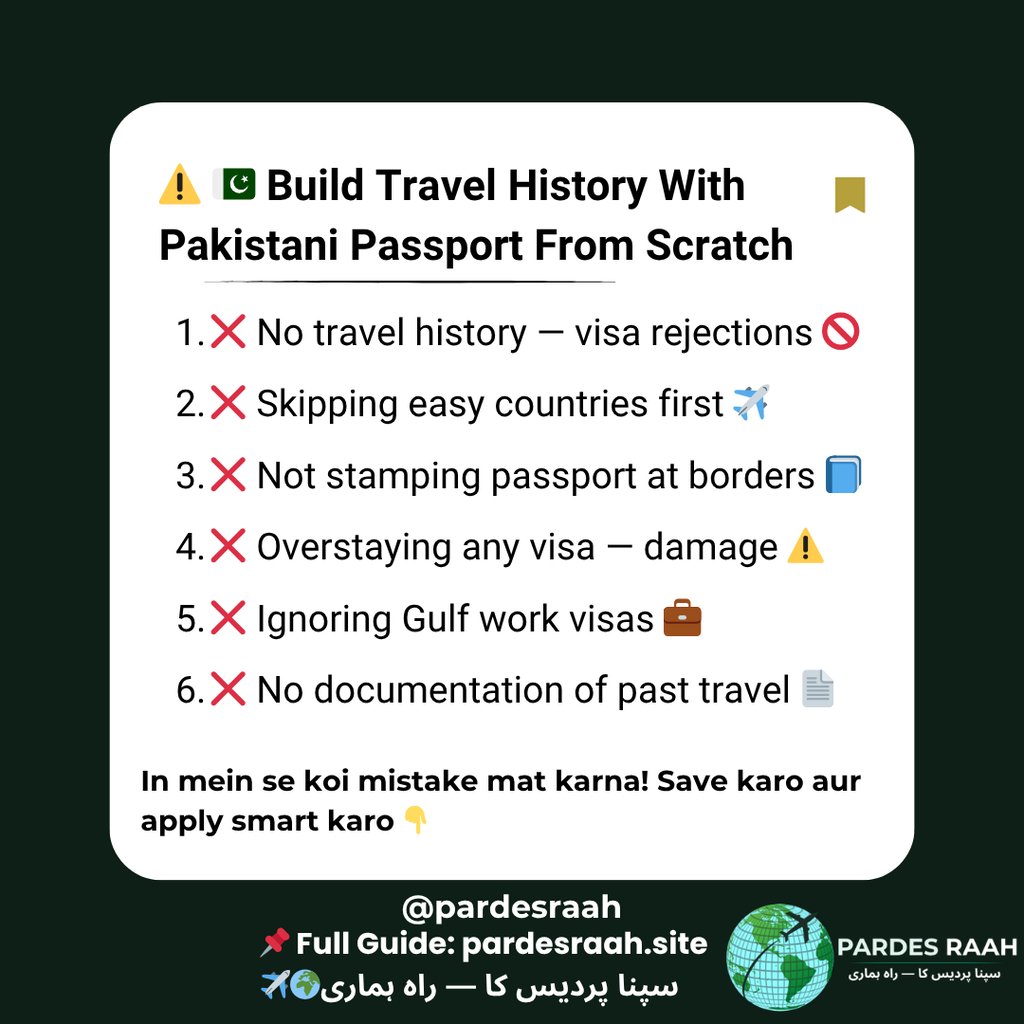
Pakistani passport ki taaqat aap ke haath mein hai — ek ek stamp se duniya ke darwaze khulte hain.
How To Build Travel History With Pakistani Passport From Scratch
Introduction:
One of the most common and deeply frustrating challenges facing Pakistani passport holders in 2026 is the vicious cycle of visa rejections caused by a lack of travel history. Visa officers reviewing Pakistani applications for Schengen visas, UK visas, Canadian visas, and other strong passport destinations frequently cite insufficient travel history as a primary reason for rejection. And yet building that travel history requires getting visas — which are often rejected due to the very absence of travel history. For many Pakistani families and individuals this cycle feels impossible to break. But it is not impossible — it simply requires a smart, strategic, and patient approach that starts with the right countries, follows the right rules, and builds a credible international travel record step by step. This guide explains exactly how to build strong travel history with a Pakistani passport from zero in 2026.
Why Does Travel History Matter So Much?
Travel history is one of the most powerful signals a visa officer uses to assess the credibility and trustworthiness of a visa applicant. When a Pakistani passport holder has a clean record of visiting multiple countries, complying with visa conditions, and returning to Pakistan on time — it tells the visa officer several critical things. It demonstrates that the applicant is a genuine traveller who respects immigration rules. It shows that the applicant has been trusted by other countries' immigration authorities and has not abused that trust. It proves that the applicant has the financial means to travel internationally. And it significantly reduces the perceived risk that the applicant will overstay or misuse a new visa. A Pakistani passport holder with stamps from Turkey, Malaysia, UAE, and Umrah visits is a fundamentally different applicant in a visa officer's eyes than one with a completely blank passport — even if all other aspects of the application are identical.
Who Is This Guide For?
This guide is for Pakistani passport holders who currently have little or no international travel history and want to strategically build a strong travel record that will improve their chances of approval for stronger destination visas in the future. It is particularly useful for young Pakistani professionals and graduates who have never travelled internationally, Pakistani families planning their first overseas trips, and Pakistani applicants who have previously been rejected for stronger visas due to insufficient travel history.
Tip 1: Start With the Easiest and Most Accessible Countries
The most important strategic decision in building travel history with a Pakistani passport is choosing where to start. Many Pakistani applicants make the mistake of immediately targeting difficult destinations like Schengen countries, the UK, or the USA for their first international trip — and face rejection because they have no existing travel history to support those applications. The smarter approach is to begin with countries that are genuinely accessible to Pakistani passport holders and build a clean and consistent travel record from there.
In 2026 the three most accessible and recommended starting points for Pakistani passport holders with no travel history are Turkey, Malaysia, and the UAE. Turkey offers a straightforward online e-Visa for just $51 at evisa.gov.tr with a standard processing time of 3 to 5 days and a low rejection rate for Pakistani applicants who have complete documents. Malaysia offers the eVisa for RM 200 at malaysiavisa.imi.gov.my with approvals frequently arriving within 24 hours and one of the lowest rejection rates available to Pakistani passport holders globally. The UAE offers multiple visit visa options that can be arranged through UAE-based family members or through travel agents for relatively accessible fees. Performing Umrah is also an excellent early travel history building step — the Saudi Umrah Visa is processed through registered travel agents within 3 to 7 days and visiting the holy cities is a deeply meaningful experience that also adds valuable international travel stamps to your passport.
Starting with these accessible destinations and visiting them cleanly — arriving legally, staying within the permitted duration, and departing before your visa expires — builds the foundation of a credible travel history that strengthens all future visa applications.
Tip 2: Always Ensure Your Passport Is Stamped at Every Border
This sounds obvious but it is a point that many Pakistani travellers miss — sometimes deliberately, sometimes out of ignorance. Every entry and exit stamp in your passport is a verifiable record of your international travel that visa officers can see, assess, and use to evaluate your application. A passport with multiple clear entry and exit stamps from different countries tells a story of a traveller who moves internationally, complies with immigration rules, and returns home as required.
Some Pakistani travellers in certain border crossing situations — particularly at land borders — may be given the option or encouraged not to have their passport stamped. This should always be declined. Every legitimate border crossing should result in an entry stamp when you arrive and an exit stamp when you depart. These stamps are your travel history evidence and without them even trips you have genuinely made leave no verifiable trace in your passport. Always actively ensure that immigration officers stamp your passport at every international entry and exit point regardless of the border type — air, land, or sea.
Tip 3: Never Overstay Any Visa Under Any Circumstances
This is the single most important rule in building and protecting a strong travel history — and breaking it even once can undo years of careful travel history building in a single act. An overstay on any visa in any country creates a permanent negative mark on your immigration record that visa officers in other countries can see, that must be declared on future visa applications, and that immediately raises serious doubts about your willingness to comply with immigration rules.
The consequences of overstaying extend far beyond the country where it occurred. A Turkish visa overstay can be flagged when you apply for a Malaysian visa. A UAE overstay can appear when you apply for a Schengen visa. Immigration systems increasingly share data across borders and even overstays that happened years ago can surface in future applications. Pakistani passport holders building their travel history must treat visa compliance as absolute and non-negotiable — book your return travel before you depart, set reminders for your visa expiry date, and depart the country you are visiting at least 2 to 3 days before your permitted stay expires to account for any unforeseen circumstances. Thirty days in Turkey means you must be on your return flight by day 29 at the absolute latest.
Tip 4: Leverage Gulf Work Visas as Travel History
Many Pakistani workers who have worked legally in Gulf Cooperation Council countries including the UAE, Saudi Arabia, Qatar, Kuwait, Bahrain, and Oman do not realise that their Gulf work visa history is a significant and valuable form of international travel history that directly strengthens future visa applications. A Pakistani professional who has worked in the UAE on a valid work visa for 2 years, returned to Pakistan at the end of their contract, and maintained a clean immigration record has demonstrated exactly the kind of responsible international mobility that Schengen and other visa officers value highly.
If you have previously worked in any Gulf country, include copies of your old passports showing the work visa stamps and entry and exit records with your future visa applications. Include a brief explanation in your cover letter noting your Gulf work history, the dates of your employment, and the fact that you returned to Pakistan at the end of your contract as required. This track record of working legally abroad and returning home is one of the most credible forms of travel history a Pakistani applicant can present because it demonstrates trustworthiness over an extended period rather than just a short tourist visit.
Tip 5: Document Every Trip Thoroughly
Building travel history is only valuable if that history is properly documented and can be presented convincingly in future visa applications. Many Pakistani travellers visit multiple countries but lose or discard the evidence of those visits — old passports, flight tickets, hotel bookings, visa copies, and bank statements from travel periods. This documentation is exactly what future visa officers need to see in order to assess and credit your travel history.
Develop the habit of creating a travel documentation folder — physical and digital — for every international trip you make. Save your flight tickets, hotel booking confirmations, visa copy or e-Visa printout, travel insurance policy, and bank statements covering the period of your trip. Photograph every relevant page of your passport including all entry and exit stamps immediately after each trip and store these photographs in cloud storage. When your passport eventually fills up and you renew to a new one, keep the old passport safely — old passports with stamps are valuable travel history evidence that can be submitted with future applications. Never discard a passport with visa stamps in it regardless of how old or expired it is.
Tip 6: Build Progressively — From Easy to More Demanding Destinations
Travel history building is a progression — not a one-step process. Once you have established clean travel records in Turkey, Malaysia, and the UAE, your application profile for slightly more demanding destinations improves significantly. After 2 to 3 clean visits to accessible countries, Pakistani applicants can begin targeting Gulf countries they have not yet visited, Asian destinations like Thailand or Azerbaijan which have relatively accessible visa processes for Pakistanis, and eventually begin preparing applications for more demanding destinations like Schengen countries using their accumulated travel history as a foundation.
Each successful trip that ends with a clean on-time departure adds another layer of credibility to your travel profile. A Pakistani passport holder who has visited Turkey twice, Malaysia once, performed Umrah, and worked for 2 years in the UAE legally is a fundamentally stronger Schengen visa applicant than someone with a blank passport — even if all other financial and employment factors are identical. The progression takes time and patience but each step builds meaningfully on the last and the cumulative effect of a well-built travel history can open doors to destinations that once seemed completely out of reach.
Fees and Costs of Starting Countries:
The Turkey e-Visa costs $51 USD which is approximately PKR 14,000. The Malaysia eVisa costs RM 200 which is approximately PKR 13,000. UAE visit visa costs vary depending on the arrangement but typically range from AED 300 to AED 700 which is approximately PKR 24,000 to PKR 56,000. Umrah packages including visa, flights, and accommodation start from approximately PKR 150,000 per person. These are very reasonable entry-level investments for building international travel history that can eventually unlock access to significantly more valuable and life-changing visa opportunities.
Processing Time:
Turkey e-Visa processing takes 3 to 5 working days. Malaysia eVisa processing takes 1 to 3 working days with many approvals arriving within 24 hours. UAE visit visa processing through a travel agent or sponsor typically takes 3 to 5 working days. Umrah Visa processing takes 3 to 7 working days through a registered travel agent. All processing times assume complete and correctly submitted applications.
Important Tips:
Always travel with comprehensive travel insurance for every international trip — it protects you during the journey and demonstrates responsible travel preparation in your future visa applications. Keep a personal travel log noting the dates, countries visited, visa types used, and entry and exit dates for every international trip you make — this log helps you accurately declare your travel history on future visa applications. When applying for stronger destination visas using your accumulated travel history, always include a personal cover letter that explicitly references your previous international travel, emphasises your clean compliance record, and draws the visa officer's attention to the stamps and records in your passport. Present your travel history as an active and proud part of your application — not something to be buried in supporting documents.
Conclusion:
Building travel history with a Pakistani passport from scratch in 2026 is not only possible — it is a proven and achievable strategy that thousands of Pakistani travellers have used to progressively access more and more of the world. Start with the most accessible destinations, always comply perfectly with visa conditions, never overstay by a single day, document every trip thoroughly, leverage your Gulf work history if you have it, and build progressively toward your ultimate travel and immigration goals. Every stamp in your passport is a vote of confidence from another country's immigration system — and with patience, discipline, and smart planning, your Pakistani passport can become a document that opens doors rather than closes them.
For free visa guides, document checklists, and daily immigration updates made for Pakistani applicants follow PardesRaah on YouTube, Instagram, Facebook, TikTok and X.
سپنا پردیس کا — راہ ہماری ✈️🌍
© PardesRaah — Pakistan's #1 Visa & Immigration Media Hub


Sapna Pardes Ka — Raah Humari
Pakistan's free daily visa and immigration information hub.
Har roz naye guides — bilkul free.
Quick Links
Visa Categories
Popular Countries
© 2026 PardesRaah. All rights reserved.
Disclaimer: All information on PardesRaah is for educational purposes only. We are not immigration lawyers or consultants.