Italy Work Visa Quota 2026 — How Pakistanis Can Apply
PardesRaah
7/22/20267 min read
Italy mein kaam karna sirf sapna nahi — 2026 mein yeh ek legal aur structured mauka hai. Sahi information se sahi tayyari karo.
Italy New Work Visa Quota 2026 — How Pakistanis Can Apply
Introduction:
Italy has announced one of the most significant expansions of its legal work visa program in recent history — and Pakistani workers are among the direct beneficiaries. Under the newly approved Decreto Flussi for 2026–2028, up to 164,850 non-EU workers will be allowed into Italy for employment in 2026 alone, covering seasonal employment, non-seasonal employment, and self-employment across a wide range of sectors. Pakistan has been specifically named in the priority country list under the new Decreto Flussi program — one of the largest labour quotas offered by any European country for Pakistan. For Pakistani workers seeking a legal, structured, and employer-sponsored pathway to work in Europe, this is one of the most important opportunities of 2026. This guide explains exactly what the Decreto Flussi is, how many slots are available for Pakistanis, which sectors are eligible, how the application process works, and what Pakistani workers must know to position themselves correctly.
What Is the Decreto Flussi?
The Decreto Flussi is the Italian government's framework defining immigration flows — a governmental decree that regulates how many non-EU workers can enter Italy for work. The newly approved Decreto Flussi for 2026–2028 lays out a three-year plan authorizing nearly 500,000 work visas for non-EU citizens, setting annual quotas for seasonal workers, non-seasonal workers, and self-employed individuals. By planning over three years Italy aims to align legal immigration with genuine labour market needs while providing predictability for both employers and overseas workers.
Who Is Affected by the 2026 Quota?
These quota announcements directly affect Pakistani workers who are seeking legal employment in Italy through the official employer-sponsored pathway, Pakistani professionals with connections to Italian employers or Italian industry contacts, and Pakistani workers currently in Italy on study or seasonal permits who may be eligible to convert their status to a work permit under the quota allocation.
Pakistan's Priority Status — 25,000 Dedicated Slots:
A Priority Countries Quota of 25,000 work visas in 2026 is reserved for citizens of 38 specified non-EU countries that have priority status, including Pakistan. This priority list is reserved for citizens of countries that hold bilateral migration agreements with Italy — nations that cooperate with Italy in managing irregular migration and accepting the repatriation of undocumented citizens.
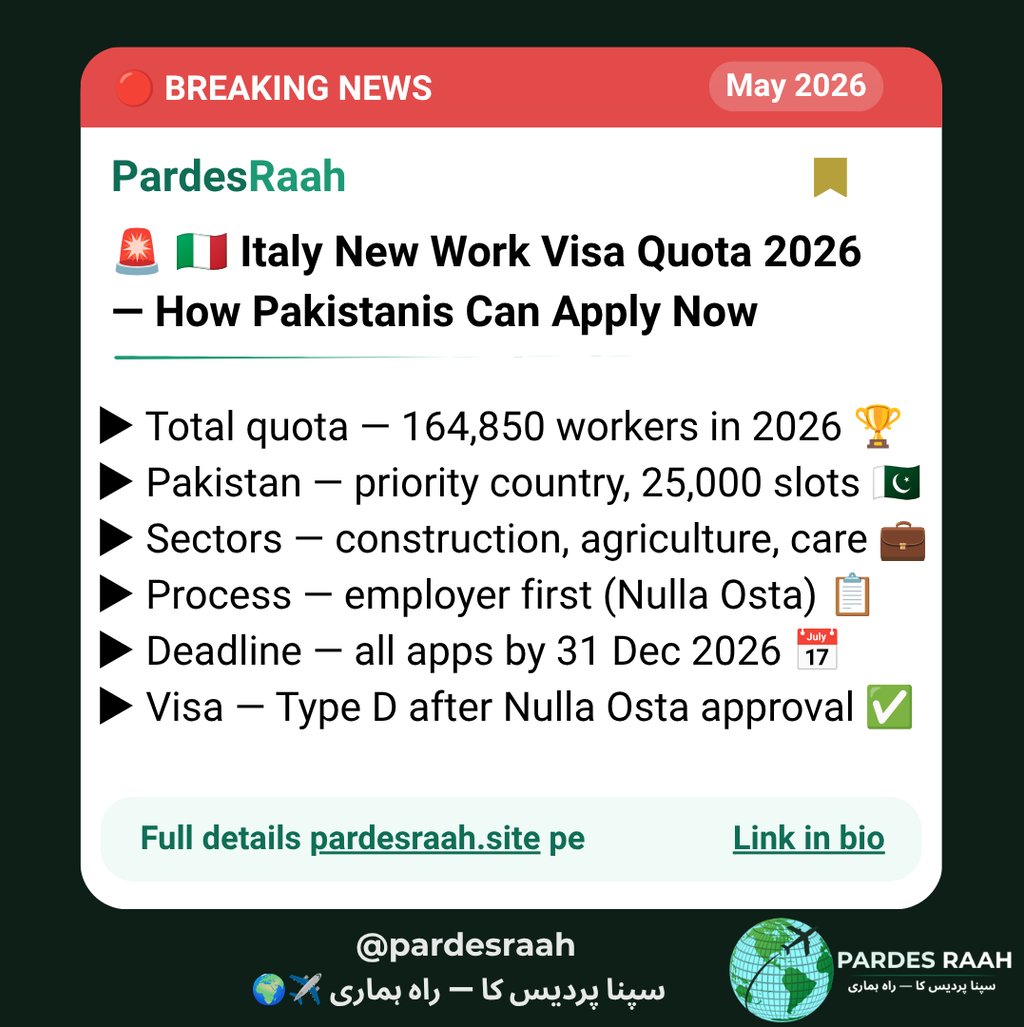
Under the approved plan, 3,500 Pakistani workers will be allowed to travel to Italy every year from 2026 to 2028 — with 1,500 in seasonal positions and 2,000 in non-seasonal jobs — making a total of 10,500 Pakistani workers over the three-year period. Pakistan's inclusion as a priority country is the result of ongoing bilateral cooperation on migration management between Pakistan and Italy and represents one of the most structured and reliable legal work pathways to Europe available to Pakistani workers in 2026.
Total Quota Breakdown for 2026:
Out of the 164,850 total slots for 2026, 88,000 are allocated to seasonal jobs in agriculture and tourism. The remaining 76,850 spots are for non-seasonal employment, including hired workers in various industries and self-employed immigrants. Within the non-seasonal quota, 13,600 permits are strictly reserved for domestic helpers and caregivers — reflecting Italy's aging population and the chronic shortage of in-home care workers.
Which Sectors Are Open to Pakistani Workers?
Unlike older decrees that severely limited the industries eligible for non-seasonal visas, the 2026–2028 plan opens the doors wide, covering construction, logistics, manufacturing, services, agriculture, tourism, and healthcare. For Pakistani workers this broad sector coverage is significant — it means that Pakistani professionals and skilled workers in construction, logistics, manufacturing, agriculture, hospitality, and domestic care are all potentially eligible for the 2026 quota depending on their specific skills and employer connections.
The Italy Work Permit Quota for Pakistani workers specifically covers key sectors such as agriculture, hospitality, and ship breaking. Pakistani workers with experience in these and other qualifying sectors should actively seek connections with Italian employers who are registered to participate in the Decreto Flussi program
How the Application Process Works — Employer First:
This is the most critical point for Pakistani workers to understand about the Italy work visa system — the Italy work visa process for Pakistanis is employer-driven, meaning the Italian employer must first apply for the worker's authorization, known as the Nulla Osta. Pakistani workers cannot apply directly — they must have a legitimate Italian employer participating in the Decreto Flussi program.
The process works as follows. The Italian employer submits an application through the ALI Immigration Portal during designated Click Days. Click Days are the specific dates when employers, employers' organisations, and authorised professionals can submit applications through the Services Portal of the Ministry of the Interior. When the Nulla Osta is approved the employer must confirm it within 7 days through the portal. Once the Nulla Osta is issued the Pakistani worker then applies for their Type D work visa at the Italian Embassy in Islamabad.
What Is a Click Day and Why Does It Matter?
The Click Day system means that quota spots fill up on a first-come, first-served basis from the moment the application window opens. Applications will open in early January 2026 for seasonal jobs and February 2026 for non-seasonal categories depending on the Click Day schedule. Italian employers who are not prepared with complete documentation at the moment the Click Day window opens risk missing out on quota slots entirely — the system processes applications in submission order and slots can fill within hours of opening.
For Pakistani workers the practical implication is that the relationship with an Italian employer and all document preparation must be completed well before the Click Day opens — not after. Pakistani workers who are actively seeking Italian employment connections should pursue these relationships now so that when an employer decides to apply for a Nulla Osta their documentation is ready.
The Type D Work Visa — Final Step for Pakistani Workers:
Once the Nulla Osta is issued, the worker has 180 days to request a work visa at the Italian Embassy or Consulate in their country. If approved, the worker receives a Type D national work visa. Processing time for the Type D visa is typically 4 to 8 weeks depending on workload and visa category. After arriving in Italy with the Type D work visa Pakistani workers must apply for a Permesso di Soggiorno — the Italian residence permit — within 8 working days of arrival at the local post office or Questura immigration office. The Permesso di Soggiorno confirms legal employment and residence status in Italy and is the foundational document for all further steps including family reunification and eventual permanent residency.
How Pakistani Workers Can Find Italian Employers:
The most important practical step for Pakistani workers interested in the Decreto Flussi pathway is establishing a connection with a legitimate Italian employer who is registered and eligible to apply for quota slots. Jobs are usually posted on Italian job platforms and the EURES European Job Portal at eures.ec.europa.eu. The Italian Embassy in Islamabad at ambislamabad.esteri.it also provides information on the official process. Pakistani workers should focus their search on sectors with confirmed demand — construction, logistics, agriculture, hospitality, and domestic care — and should be extremely cautious about any Pakistani agent or recruiter claiming to arrange Italian Nulla Osta applications directly, as only Italian employers can submit these applications through the official government portal.
Critical Fraud Warning:
Many people are being deceived by scammers who offer to help with visas and work permits, charge money, and then disappear. The Italy work visa process is employer-driven and government-controlled — no Pakistani agent, immigration consultant, or recruitment company can submit a Nulla Osta application on behalf of an employer or guarantee a quota slot. Any person or organization in Pakistan claiming to offer guaranteed Italian work visas through the Decreto Flussi for an upfront fee is almost certainly fraudulent. Pakistani workers should never pay any fee to an agent for Italian Nulla Osta facilitation and should verify any Italian employer's legitimacy through official channels before entering any financial or contractual arrangement.
Deadline and Key Dates:
All applications for the 2026 quota must be submitted by 31 December 2026. Pakistani workers who are actively seeking Italian employment should pursue employer connections urgently given that Click Day slots fill rapidly and the overall quota window closes at year end. The 2027 and 2028 quotas under the same Decreto Flussi framework will provide additional annual opportunities for Pakistani workers who do not secure a position in the 2026 cycle.
Processing Time:
The complete Italy work visa process from Nulla Osta application to Type D visa typically takes several months. The Nulla Osta application and approval by Italian authorities takes approximately 60 to 90 days from the Click Day. After Nulla Osta approval the Type D work visa processing at the Italian Embassy in Islamabad takes 4 to 8 weeks. Pakistani workers should plan for a total timeline of 4 to 6 months from Click Day to arrival in Italy.
Important Tips:
Focus on sectors where Pakistan's dedicated 25,000 priority quota applies — non-seasonal employment in construction, logistics, care, and manufacturing. Build a genuine connection with a legitimate Italian employer rather than relying on Pakistani agents. Use official job platforms including EURES at eures.ec.europa.eu and the Italian Embassy's official resources. Never pay any upfront fee to any agent claiming to guarantee a Nulla Osta. Prepare all required documents — passport, educational certificates, experience evidence — well before the Click Day opens so that when an Italian employer decides to proceed, no time is lost on the Pakistani worker's side.
Conclusion:
Italy's Decreto Flussi 2026 represents one of the most significant and genuinely accessible legal work visa opportunities available to Pakistani workers in Europe. With 164,850 total slots in 2026, Pakistan named as a priority country with 25,000 dedicated non-seasonal positions, and a wide range of eligible sectors spanning construction, agriculture, care, logistics, and hospitality, the opportunity is real, structured, and government-backed. The pathway is employer-driven — Pakistani workers must find legitimate Italian employers, not agents — and the Click Day system rewards preparation and timing. Fraud is prevalent and Pakistani workers must approach every agent offering guaranteed placements with extreme caution. For Pakistani workers who navigate this process correctly through legitimate employer connections, Italy in 2026 offers a genuinely life-changing legal European work opportunity.
For free visa guides, document checklists, and daily immigration updates made for Pakistani applicants follow PardesRaah on YouTube, Instagram, Facebook, TikTok and X.
سپنا پردیس کا — راہ ہماری ✈️🌍
© PardesRaah — Pakistan's #1 Visa & Immigration Media Hub
Sapna Pardes Ka — Raah Humari
Pakistan's free daily visa and immigration information hub.
Har roz naye guides — bilkul free.
Quick Links
Visa Categories
Popular Countries
© 2026 PardesRaah. All rights reserved.
Disclaimer: All information on PardesRaah is for educational purposes only. We are not immigration lawyers or consultants.