Saudi Arabia Hajj Visa: Checklist for Pakistani Muslims
PardesRaah
6/19/202610 min read
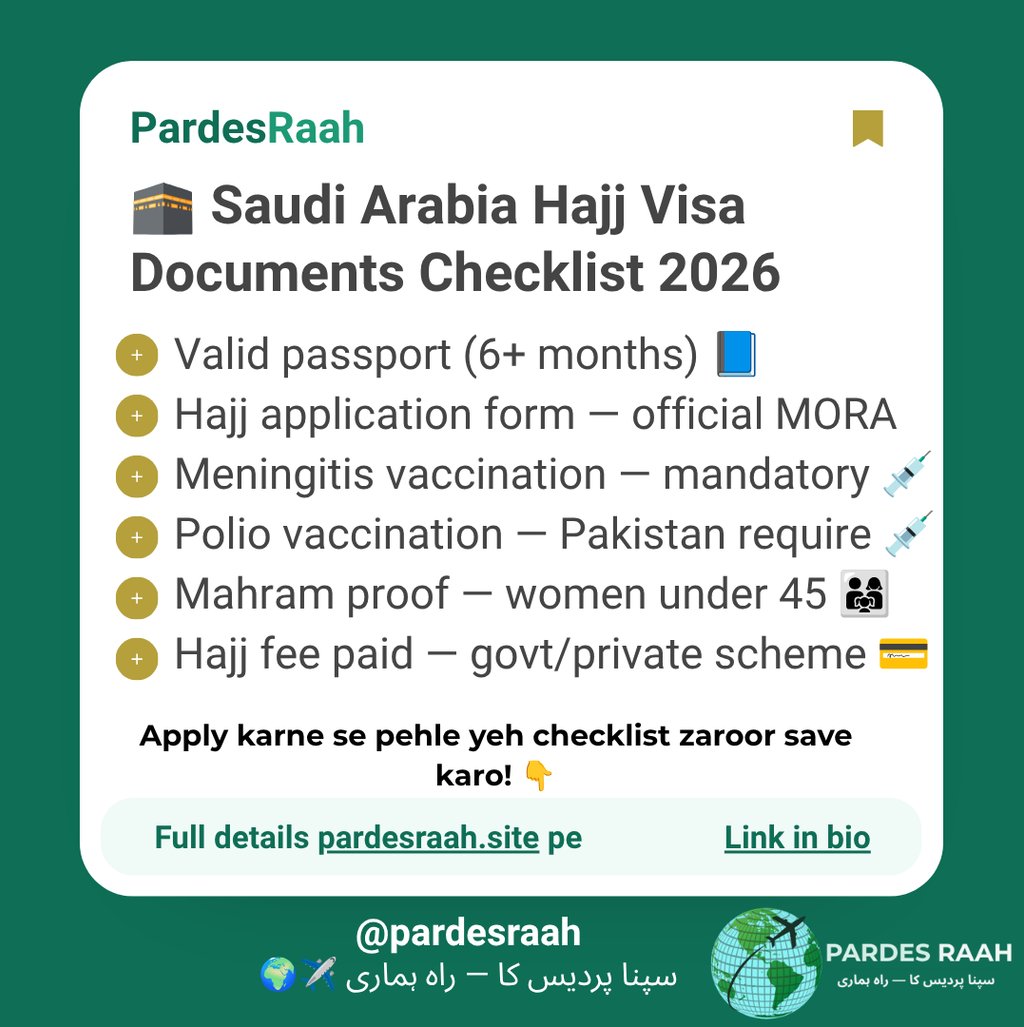
Baitullah ka safar — har Pakistani Muslim ka sabse bada sapna aur sabse badi khwahish. Sahi documents se yeh safar asaani se shuru hota hai.
Saudi Arabia Hajj Visa — Complete Documents and Requirements
Introduction:
Hajj is the fifth pillar of Islam and the most sacred journey a Muslim can undertake in their lifetime. For Pakistani Muslims the Hajj pilgrimage to the holy cities of Mecca and Medina is not simply a travel experience — it is a profoundly spiritual obligation, a deeply emotional fulfillment, and a moment that defines the arc of an entire Muslim life. Pakistan has been allocated a Hajj quota of 179,210 pilgrims and the Ministry of Religious Affairs Pakistan is managing both the Government Hajj Scheme and the Private Hajj Scheme to facilitate Pakistani Muslims in performing this sacred duty. But successfully completing the Hajj application process requires a complete, correctly prepared, and precisely organised document file. Every document on the checklist serves a specific purpose and submitting an incomplete or incorrectly prepared application can result in rejection from the quota regardless of how sincerely a family has prayed and saved for this journey. This guide gives Pakistani Muslims the complete Saudi Arabia Hajj Visa documents checklist along with detailed explanations, fees, and step-by-step application instructions.
What Is the Saudi Arabia Hajj Visa?
The Saudi Arabia Hajj Visa is a special purpose visa issued by the Saudi government exclusively to Muslims performing the annual Hajj pilgrimage during the Islamic month of Dhul Hijjah. It is fundamentally different from all other Saudi visas — it is not available independently and cannot be applied for directly through the Saudi Embassy in Islamabad. Instead the Hajj Visa for Pakistani Muslims is processed entirely through the Ministry of Religious Affairs Pakistan, known as MORA, at mora.gov.pk, either through the Government Hajj Scheme or through a Ministry-approved Private Hajj Tour Operator. The visa is tied to the specific Hajj season and is valid only for the designated Hajj period — typically allowing Pakistani pilgrims to stay in Saudi Arabia for 30 to 40 days covering the full Hajj rituals and Ziyarat visits.
Who Needs This Checklist?
This checklist is for Pakistani Muslim men, women, and families who are planning to apply for Hajj through either the Government Hajj Scheme or the Private Hajj Scheme and need to understand exactly what documents are required for a complete and successful Hajj application. It is particularly important for first-time Hajj applicants and for families applying under the balloting system who want to ensure their application is not disqualified on document grounds.
Document 1: Valid Pakistani Passport
Your passport must have a minimum validity of 6 months from your intended departure date for Hajj and must have sufficient blank pages for the Hajj Visa stamp. Before beginning the Hajj application process check your passport expiry date very carefully. Pakistan's Hajj season falls in the second half of the year during the Islamic month of Dhul Hijjah — and your passport must remain valid for at least 6 months beyond your expected return date from Saudi Arabia. If your passport is expiring within 6 to 8 months from now, renew it immediately at passport.gov.pk before submitting your Hajj application. A passport renewal during the Hajj application process can cause delays that result in missing the quota allocation. If you have recently renewed your passport, ensure your new passport details are consistently used throughout the entire Hajj application rather than mixing old and new passport information.
Document 2: CNIC — Original and Copy
The Computerized National Identity Card is a mandatory identity document for the Hajj application and must be submitted in both original form for verification at the application stage and as a photocopy for the application file. Your CNIC must be valid and not expired — an expired CNIC is not acceptable for Hajj application purposes and will result in the application being rejected at the initial processing stage. Pakistani Muslims whose CNICs are expiring should renew at their nearest NADRA office before beginning the Hajj application. The CNIC is used to verify the applicant's Pakistani nationality and identity and must match all other submitted documents exactly — any discrepancy between the name or date of birth as shown on the CNIC and the passport is a common cause of application complications that must be resolved before submission.
Document 3: Hajj Application Form From MORA
The official Hajj application form is issued and managed by the Ministry of Religious Affairs Pakistan. For Government Hajj Scheme applicants the form is available at mora.gov.pk and at designated branches of government-approved banks across Pakistan. The form must be completed carefully and completely — every field must be filled with accurate information that matches the applicant's passport and CNIC exactly. The form covers personal details, passport information, next of kin details, health information, and accommodation preferences. Any erasures, corrections, or inconsistencies in the form can cause delays or rejection. Pakistani families applying together as a group must ensure all family members' forms are completed in a fully consistent and cross-referenced manner.
For Private Hajj Scheme applicants the application form is provided by the selected Ministry-approved private Hajj tour operator. Pakistani Muslims using the private scheme should select their operator from the official list of approved operators published by MORA and confirm that their operator is currently registered and approved. MORA maintains an updated list of approved private Hajj operators on their official website and Pakistani Muslims should verify their operator's status before making any payments.
Document 4: Meningitis Vaccination Certificate
The meningitis vaccination is a mandatory health requirement for all Pakistani Hajj applicants — without exception. Saudi Arabia requires proof of meningitis vaccination as a condition of entry for all Hajj pilgrims due to the exceptionally high risk of meningitis transmission in the large crowd conditions of the Hajj season. The vaccination must be administered at least 10 days before the departure date for it to be considered effective by Saudi health authorities.
The meningitis vaccine must be administered at a recognised health facility and the certificate must be issued on official health authority letterhead. In Pakistan meningitis vaccinations for Hajj purposes are available at major government hospitals, approved vaccination centres, and district health offices across the country for a cost of approximately PKR 3,000 to PKR 5,000. The vaccination certificate must accompany the Hajj application and must also be carried by the pilgrim during travel as it may be checked at the Saudi port of entry. Pakistani Hajj applicants must ensure their meningitis vaccination certificate is current — previous certificates from prior years are not accepted and a fresh vaccination is required for each Hajj application.
Document 5: Polio Vaccination Certificate
In addition to the meningitis vaccination, Pakistani Hajj applicants are specifically required to provide proof of polio vaccination. This requirement applies to Pakistanis because Pakistan remains one of the few countries in the world where wild poliovirus transmission continues, and Saudi Arabia imposes a polio vaccination requirement on all travellers from polio-endemic countries as a public health protection measure for the millions of pilgrims gathered during Hajj. The polio vaccination must be administered within 12 months of the intended Hajj departure date and the certificate confirming vaccination must be included with the application documents.
The oral polio vaccine is available free of charge at all government health centres and district health offices throughout Pakistan. Pakistani Hajj applicants should visit their nearest government health facility to receive the vaccine and obtain the official vaccination certificate. The certificate must clearly show the applicant's name, the date of vaccination, and the official stamp of the health facility. Pakistani Hajj applicants who have recently received polio vaccination as part of a national immunisation campaign should retain their vaccination records as these may be accepted as meeting this requirement.
Document 6: Passport Size Photographs
Two recent passport size photographs meeting Saudi and MORA specifications must be submitted with the Hajj application. The photographs must have a plain white background, show the full face clearly from the front with both eyes visible, be taken within the last 3 months, and be in colour. For Pakistani female applicants wearing hijab, the full face must be visible from forehead to chin — hair coverings are acceptable but the entire face must be unobstructed and clearly visible. The standard photograph size for Pakistani Hajj applications is 35mm by 45mm. Pakistani applicants should have their Hajj photographs taken at a professional photography studio and confirm the correct size and background specifications before the session.
Document 7: Mahram Proof — Mandatory for Women Under 45
One of the most important and specific requirements of the Saudi Arabia Hajj system for Pakistani female applicants is the mahram rule. Under Saudi Hajj regulations, Pakistani Muslim women under the age of 45 are required to be accompanied by a mahram — a male guardian who is a close male relative from whom marriage is permanently forbidden under Islamic law. Acceptable mahrams include husband, father, father-in-law, son, brother, nephew, paternal uncle, and maternal uncle.
The mahram proof documentation must include the male guardian's valid Pakistani passport copy, a copy of his CNIC, and clear documentary proof of the relationship between him and the female applicant. For a husband-wife relationship this is the Nikahnama — the official Islamic marriage certificate. For a father-daughter relationship this is the female applicant's birth certificate showing the father's name. For brother-sister relationships this may include family registration documents or birth certificates that demonstrate the family connection. All mahram relationship documents must be consistent and clearly legible — unofficial or incomplete relationship documentation is a common source of Hajj application complications for Pakistani women.
Pakistani Muslim women aged 45 and above have a significant facilitation in the Hajj system — they may perform Hajj without a mahram provided they travel as part of an official organised group of Pakistani women arranged through an approved Hajj scheme or operator. This group arrangement must be confirmed through the official MORA-approved scheme or operator and the necessary group registration documentation must be completed as part of the application.
Document 8: Hajj Fee Payment Confirmation
The Hajj fee must be paid through officially designated channels before the application can be considered complete and the applicant's file forwarded for processing. For the Government Hajj Scheme the Hajj fee starts from approximately PKR 1,200,000 per person for standard accommodation packages and must be deposited at the specific government-designated banks announced by MORA for the Hajj season. The payment must be made through the exact banking channels specified by MORA — payments through other methods or non-designated banks are not accepted and do not qualify the applicant for the scheme.
For the Private Hajj Scheme the fees range from approximately PKR 1,500,000 to PKR 1,800,000 per person depending on the operator and accommodation category selected. Private scheme fees must be paid directly to the registered and MORA-approved private Hajj tour operator according to their specified payment schedule. Pakistani families using the private scheme should ensure they receive official payment receipts from their operator for every payment made and should verify the operator's MORA registration before making any financial commitment.
The Hajj fee payment confirmation or receipt must be included with the application documents as proof of fee payment. Without confirmed fee payment the application is considered incomplete regardless of how complete all other documents are.
The Balloting System — Understanding Pakistan's Hajj Quota:
Pakistan's Hajj quota of 179,210 pilgrims is divided between the Government Hajj Scheme and the Private Hajj Scheme. When the number of applicants for either scheme exceeds the available quota seats — which happens regularly particularly in the Government Hajj Scheme — a computerised balloting system is used to select which applicants receive the confirmed Hajj seat allocation. This means that submitting a complete and correct application does not guarantee selection — it only ensures eligibility for the ballot. Pakistani families who have previously been selected in the ballot are given priority consideration in subsequent years in some scheme structures. Pakistani applicants who are not selected in a given year's ballot are refunded their deposit and encouraged to reapply in the following year.
Step-by-Step Application Process:
The first step is to renew your passport and CNIC if either is expiring before completing the process. The second step is to receive the meningitis and polio vaccinations and obtain official certificates. The third step is to obtain the official Hajj application form from mora.gov.pk or a designated bank for Government Hajj Scheme, or from your chosen MORA-approved private operator for Private Hajj Scheme. The fourth step is to complete the Hajj application form carefully and accurately matching all details to your passport and CNIC. The fifth step is to pay the Hajj fee through the official designated bank channels for Government Hajj Scheme or through your private operator for Private Hajj Scheme. The sixth step is to gather all required documents including photographs and mahram documentation if applicable and submit the complete application file. The seventh step is to await the balloting result for Government Hajj Scheme applicants and the confirmation from the private operator for Private Hajj Scheme applicants. The eighth step is to complete any additional health or documentation requirements communicated by MORA after selection. The ninth step is to receive the Hajj Visa and complete pre-departure preparations including packing, orientation sessions, and flight arrangements.
Fees and Costs Summary:
The Government Hajj Scheme package starts from approximately PKR 1,200,000 per person. The Private Hajj Scheme packages range from approximately PKR 1,500,000 to PKR 1,800,000 per person depending on accommodation category and operator. The meningitis vaccination costs PKR 3,000 to PKR 5,000 per person. The polio vaccination is available free of charge at government health centres. Passport size photographs cost approximately PKR 200 to PKR 500 per set. Document photocopying and preparation costs are minimal. The total investment for a Pakistani couple performing Hajj 2026 through the Government Hajj Scheme is approximately PKR 2,400,000 and through the Private Hajj Scheme approximately PKR 3,000,000 to PKR 3,600,000.
Processing Time:
The Ministry of Religious Affairs Pakistan typically opens Hajj registration for the following year's Hajj season several months in advance. For Hajj registration dates and deadlines are published on mora.gov.pk. The balloting result for the Government Hajj Scheme is announced within a few weeks of the registration closing date. Pakistani applicants should monitor the official MORA website and the PardesRaah website at pardesraah.site for the most current registration opening dates, deadlines, and balloting announcements for Hajj.
Important Tips:
Never pay Hajj fees to any agent or individual who is not an officially MORA-registered and approved operator — Hajj fraud through unregistered operators has cost Pakistani families enormous sums of money in previous years and is a recurring problem that Pakistani Muslims must guard against actively. Attend the official pre-Hajj orientation sessions that MORA organises for selected pilgrims — these sessions cover Hajj rituals, health precautions, safety guidelines, and practical arrangements that are essential for a safe and spiritually fulfilling Hajj. Ensure all family members travelling for Hajj are in good physical health and consult a doctor before departure if any family member has ongoing medical conditions. Carry all Hajj documents including vaccination certificates, the Hajj Visa, accommodation details, and emergency contact information in a secure and accessible manner throughout the journey.
Conclusion:
Hajj 2026 is a profound spiritual opportunity for Pakistani Muslim families who have the blessing and the means to undertake this sacred journey. The document requirements are specific, the vaccination requirements are mandatory, the fees are significant, and the balloting system means preparation and correctness matter enormously. But every step of this process is achievable for Pakistani families who approach it with careful preparation, complete documentation, and honest engagement with the official MORA system. Follow this complete checklist precisely, verify every document against your passport and CNIC, complete your vaccinations early, and submit your application through official channels only.
May Allah accept the Hajj of every Pakistani Muslim who makes this blessed journey.
For free visa guides, document checklists, and daily immigration updates made for Pakistani applicants follow PardesRaah on YouTube, Instagram, Facebook, TikTok and X.
سپنا پردیس کا — راہ ہماری ✈️🌍
© PardesRaah — Pakistan's #1 Visa & Immigration Media Hub
Sapna Pardes Ka — Raah Humari
Pakistan's free daily visa and immigration information hub.
Har roz naye guides — bilkul free.
Quick Links
Visa Categories
Popular Countries
© 2026 PardesRaah. All rights reserved.
Disclaimer: All information on PardesRaah is for educational purposes only. We are not immigration lawyers or consultants.