Saudi Arabia vs UAE Work Visa for Pakistani Workers 2026
PardesRaah
6/16/20269 min read
Gulf mein apna future banana chahte hain — sahi destination choose karna pehla aur sabse important qadam hai.
Saudi Arabia Work Visa vs UAE Work Visa — Where Should You Go
Introduction:
For millions of Pakistani families the Gulf Cooperation Council countries represent the most immediate and accessible pathway to a better income, a more stable life, and the ability to support loved ones back home. Among all GCC destinations Saudi Arabia and the United Arab Emirates stand out as the two most popular and most established work destinations for Pakistani workers and professionals in 2026. Together these two countries host the vast majority of Pakistan's approximately 9 million overseas workers. But choosing between Saudi Arabia and the UAE is a decision that carries enormous consequences for Pakistani workers and their families — affecting their salary, their savings potential, their lifestyle, their family arrangements, and their long-term settlement prospects. This guide gives Pakistani workers and professionals a complete, honest, and detailed comparison of both destinations so you can make the right choice for your specific situation in 2026.
Pakistan's Relationship With Saudi Arabia and UAE:
Pakistan has deep and longstanding ties with both Saudi Arabia and the UAE that go back decades.
Saudi Arabia is the single largest destination for Pakistani labour workers and has hosted Pakistani workers in construction, healthcare, transportation, domestic services, and technical trades since the 1970s.
The UAE — particularly Dubai and Abu Dhabi — has become the primary destination for Pakistani professionals, skilled workers, and business people and is home to the largest Pakistani community abroad with over 1.5 million Pakistanis.
Both countries maintain strong bilateral relationships with Pakistan, both host enormous and well-established Pakistani communities, and both offer zero income tax environments that make them particularly attractive for Pakistani workers compared to Western destinations.
Who Should Read This Guide?
This guide is for Pakistani workers and professionals who are deciding between Saudi Arabia and the UAE as their next overseas work destination in 2026. It is particularly useful for Pakistani workers currently in one country considering a move to the other, Pakistani families planning their first Gulf work experience, and Pakistani professionals weighing long-term career and settlement options between the two destinations.:
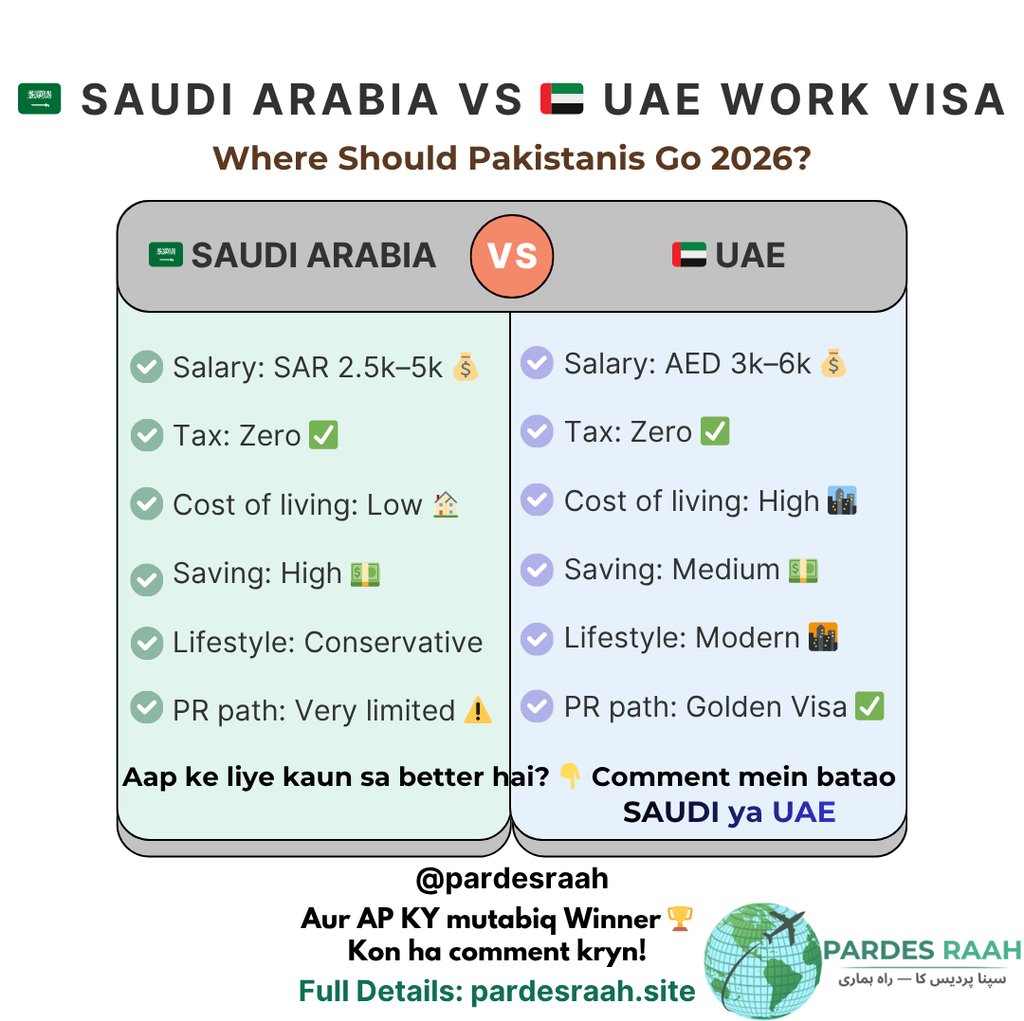
Salary Comparison:
Salary is the most immediate and practical factor for most Pakistani workers choosing between Saudi Arabia and the UAE.
In Saudi Arabia the average monthly salary for Pakistani workers varies significantly by sector and experience. Semi-skilled and skilled workers in construction, maintenance, and technical trades typically earn SAR 1,500 to SAR 3,000 per month. Pakistani professionals in engineering, healthcare, IT, and management earn SAR 4,000 to SAR 8,000 or more per month. Entry-level and unskilled workers in domestic services, retail, and hospitality typically earn SAR 800 to SAR 1,500 per month.
In the UAE monthly salaries for Pakistani workers are generally higher across most categories. Skilled and technical workers in construction, maintenance, and trades typically earn AED 2,000 to AED 4,000 per month. Pakistani professionals in engineering, IT, finance, and management earn AED 5,000 to AED 15,000 or more depending on seniority and sector. Entry-level service workers earn approximately AED 1,200 to AED 2,500 per month. The UAE's more diversified economy — with strong finance, technology, tourism, and real estate sectors — creates more high-paying professional opportunities than Saudi Arabia for Pakistani professionals with advanced qualifications and international experience.
Both Saudi Arabia and the UAE offer zero personal income tax — meaning Pakistani workers keep their full gross salary without any income tax deduction. This is one of the most significant financial advantages of Gulf employment for Pakistani workers compared to working in the UK, Canada, Australia, or Germany where income tax rates significantly reduce take-home pay.
Cost of Living and Saving Potential:
While the UAE offers higher salaries across most categories, its cost of living — particularly in Dubai and Abu Dhabi — significantly erodes the salary advantage compared to Saudi Arabia. Dubai is consistently ranked among the most expensive cities in the world for expatriates. Rental costs for a one-bedroom apartment in central Dubai range from AED 60,000 to AED 100,000 per year. Food, schooling for children, healthcare, and entertainment all carry premium price tags in the UAE's major cities. Pakistani workers in the UAE who are not provided with employer-arranged accommodation face very high housing costs that can consume a substantial portion of their monthly salary.
Saudi Arabia's cost of living is significantly lower — particularly in cities like Riyadh, Jeddah, Dammam, and smaller industrial cities where many Pakistani workers are employed. Rental costs, food prices, transportation, and daily living expenses are all considerably more affordable in Saudi Arabia than in the UAE's major cities. Many Pakistani workers in Saudi Arabia also receive employer-provided accommodation and meals as part of their employment package — particularly in construction, healthcare, and industrial sectors — which dramatically reduces their living costs and increases their net savings.
The practical implication for Pakistani workers focused primarily on maximising their savings and remittances to Pakistan is that Saudi Arabia often delivers better net savings despite lower gross salaries. A Pakistani worker earning SAR 3,000 per month in Saudi Arabia with employer-provided accommodation and meals might save SAR 2,000 to SAR 2,500 per month. A Pakistani worker earning AED 4,000 per month in the UAE while paying AED 2,500 in rent and other expenses might save only AED 1,000 to AED 1,500 per month. For Pakistani families whose primary goal is maximising money sent home to Pakistan, Saudi Arabia's lower cost structure often makes it the more financially efficient choice.
Lifestyle and Cultural Environment:
Lifestyle considerations are deeply personal and vary enormously among Pakistani workers but they represent a genuinely important factor in the quality of daily life for Pakistani expatriates in either country.
Saudi Arabia operates under a conservative Islamic framework that is culturally very familiar and comfortable for most Pakistani Muslim workers. The country has undergone significant social liberalisation in recent years under Vision 2030 but remains a deeply religious and socially conservative society. Alcohol is completely prohibited. Public entertainment is increasingly available but remains limited compared to Western standards. The large and well-established Pakistani community in Saudi Arabia means Pakistani food, Pakistani cultural events, Pakistani social networks, and Pakistani religious observance are all easily accessible across major Saudi cities.
The UAE — particularly Dubai and Abu Dhabi — offers a dramatically different lifestyle experience. The UAE is one of the most cosmopolitan and internationally diverse societies in the world. While formally an Islamic state the UAE maintains a highly liberal social environment that accommodates a wide range of lifestyles. Alcohol is available in licensed venues. World-class entertainment, shopping, dining, recreation, and cultural attractions are all available in abundance. The UAE's modern infrastructure, international connectivity, and globally oriented business environment create a very different daily experience from Saudi Arabia.
For Pakistani professionals with families seeking a more internationally oriented lifestyle, career opportunities in diverse global industries, and an environment that is exciting and dynamic — the UAE offers unmatched appeal. For Pakistani workers who value cultural familiarity, strong Islamic environment, lower costs, and maximum savings — Saudi Arabia's conservative and lower-cost environment may be more suitable and comfortable.
Family and Community:
Both countries have very large and well-established Pakistani communities that provide strong social support networks for newly arrived Pakistani workers.
Saudi Arabia hosts approximately 2.5 million Pakistanis making it the single largest Pakistani expatriate community in the world. The UAE hosts approximately 1.5 million Pakistanis concentrated primarily in Dubai, Abu Dhabi, and Sharjah. In both countries Pakistani workers can find Pakistani restaurants, Pakistani cultural associations, Pakistani schools, Pakistani mosques, and Pakistani professional networks in virtually every major city.
For Pakistani workers who want to bring their families to live with them the UAE offers more accessible family sponsorship — a Pakistani worker earning AED 4,000 per month or more can typically sponsor their spouse and children's residence visas. However the high cost of living in the UAE means family maintenance costs are significantly higher. In Saudi Arabia family sponsorship is also available for workers meeting minimum salary requirements but the lower cost of living makes family maintenance more affordable relative to income. The availability of quality international schools — important for Pakistani families with school-age children — is better in the UAE, particularly in Dubai where Pakistani children have access to a wide range of high-quality educational options.
PR Pathway and Long-Term Settlement:
This is perhaps the most consequential difference between Saudi Arabia and the UAE for Pakistani workers with long-term settlement ambitions. Saudi Arabia has historically offered very limited pathways to permanent residency or long-term settlement for overseas workers regardless of how long they have worked in the country.
The Saudi Iqama — the residence permit — must be renewed regularly and is tied to employment sponsorship. A small and expensive Premium Residency permit has been introduced in recent years for high-net-worth investors but this is not accessible to the vast majority of Pakistani workers. For most Pakistani workers Saudi Arabia is a temporary work destination with no realistic pathway to permanent settlement.
The UAE offers a significantly more structured and accessible long-term settlement pathway through the Golden Visa program. The UAE Golden Visa is a 10-year renewable residence visa available to skilled professionals earning a minimum monthly salary of AED 30,000, investors with a minimum real estate investment of AED 2 million, outstanding students, and exceptional talent in various fields. Pakistani professionals who build their careers in the UAE and achieve Golden Visa eligibility gain a level of residence security and long-term stability that simply does not exist in Saudi Arabia. The Golden Visa does not require continuous presence in the UAE — allowing Pakistani Golden Visa holders to travel and work internationally while maintaining their UAE residence. For Pakistani professionals with the qualifications and income to qualify, the UAE Golden Visa represents a genuine and valuable long-term settlement pathway in one of the world's most dynamic economies.
Job Market and Opportunities:
Saudi Arabia's job market for Pakistani workers is primarily concentrated in construction, infrastructure, healthcare, education, domestic services, and government-related projects. Saudi Vision 2030 is driving an enormous wave of infrastructure investment and development projects across the country — creating significant demand for Pakistani engineers, technicians, construction workers, and healthcare professionals. The Vision 2030 projects including NEOM, the Red Sea Project, and various entertainment and tourism developments are among the largest construction programs in the world and represent a sustained source of employment for Pakistani workers and professionals across the skills spectrum.
The UAE's job market is more diverse and internationally oriented. Dubai and Abu Dhabi's economies span finance, trade, tourism, real estate, technology, media, logistics, and professional services. This diversity creates opportunities for Pakistani workers and professionals across a much wider range of occupations and career levels than Saudi Arabia. Pakistani IT professionals, finance specialists, marketing experts, hospitality workers, and creative professionals all find strong opportunities in the UAE. The UAE's position as a global business hub also means that UAE-based employment often provides Pakistani professionals with more internationally transferable career experience and professional networks than Saudi Arabia-based employment.
Work Visa Process Comparison:
Both Saudi Arabia and the UAE require Pakistani workers to have a confirmed job offer from a registered employer before the work visa can be processed.
For Saudi Arabia the work visa is processed through the Saudi Embassy in Islamabad with the employer initiating the process through the Saudi Ministry of Human Resources. Required documents include a valid passport, attested educational or professional qualifications, a GAMCA medical fitness certificate, a police clearance certificate, and a signed employment contract. The Saudi work visa processing time is typically 2 to 4 weeks after complete document submission.
For the UAE the work visa is processed through the UAE Ministry of Human Resources and Emiratisation and the General Directorate of Residency and Foreigners Affairs. Required documents are similar — valid passport, attested qualifications, GAMCA medical certificate, police clearance, and employment contract. UAE work visa processing typically takes 5 to 14 working days. Both processes require the employer to be the sponsoring party and both require the worker to be medically fit as determined by a GAMCA-approved examination at approved centers in Pakistan.
Fees and Costs:
For Saudi Arabia the work visa processing is typically handled by the Saudi employer and the associated visa fee of approximately SAR 300 is usually employer-paid. Pakistani workers typically incur costs for the GAMCA medical examination — PKR 6,000 to PKR 8,000 — document attestation — PKR 10,000 to PKR 20,000 — and police clearance — PKR 1,000. Total out-of-pocket costs for a Pakistani worker applying for a Saudi work visa are typically PKR 20,000 to PKR 35,000.
For the UAE the work visa fee is typically AED 300 to AED 500 and is usually employer-paid. Pakistani workers incur similar out-of-pocket costs for GAMCA medical, document attestation, and police clearance totalling approximately PKR 20,000 to PKR 40,000. After arrival in the UAE Pakistani workers must also pay for their Emirates ID — AED 100 to AED 370 — which has no equivalent mandatory document cost in Saudi Arabia.
Processing Time:
Saudi Arabia work visa processing takes 2 to 4 weeks after complete document submission including employer processing time.
UAE work visa processing takes 5 to 14 working days for the work visa itself with the full residence visa process taking 3 to 4 weeks after arrival in the UAE. Both timelines assume complete and correctly prepared document submissions.
Which Destination Is Right For You?
If your primary goal is maximising savings and remittances to Pakistan, working in a culturally familiar Islamic environment, and you are in a skilled trade, construction, healthcare, or technical field — Saudi Arabia is likely the more financially efficient and culturally comfortable choice in 2026. If your primary goal is career development in a globally recognised business environment, accessing diverse professional opportunities, building toward long-term settlement through the Golden Visa, and you have professional qualifications in IT, finance, engineering, or management — the UAE offers unmatched opportunities and a clearer long-term future.
Conclusion:
Both Saudi Arabia and the UAE are excellent and legitimate work destinations for Pakistani workers and professionals in 2026 — and both have served Pakistani families as reliable sources of income and opportunity for decades. Saudi Arabia wins on lower living costs, higher savings potential, cultural familiarity, and the sheer scale of Vision 2030 employment opportunities. The UAE wins on higher professional salaries, lifestyle quality, career diversity, and the availability of the Golden Visa as a genuine long-term settlement pathway. The right choice depends entirely on your skills, your career stage, your family situation, your financial goals, and your long-term ambitions. Choose wisely — because the right Gulf destination can transform not just your career but your family's entire future.
For free visa guides, document checklists, and daily immigration updates made for Pakistani applicants follow PardesRaah on YouTube, Instagram, Facebook, TikTok and X.
سپنا پردیس کا — راہ ہماری ✈️🌍
© PardesRaah — Pakistan's #1 Visa & Immigration Media Hub


Sapna Pardes Ka — Raah Humari
Pakistan's free daily visa and immigration information hub.
Har roz naye guides — bilkul free.
Quick Links
Visa Categories
Popular Countries
© 2026 PardesRaah. All rights reserved.
Disclaimer: All information on PardesRaah is for educational purposes only. We are not immigration lawyers or consultants.