Saudi Arabia Work Visa New Rules 2026 — Pakistani Workers
PardesRaah
6/22/20269 min read
Saudi Arabia mein apna haq jaano — 2026 ke naye rules Pakistani workers ki taraf hain, agar aap inhe jaante hain.
Saudi Arabia Work Visa New Rules 2026 — Full Update For Pakistanis
Introduction:
Saudi Arabia is the single largest destination for Pakistani overseas workers — home to approximately 2.5 million Pakistanis who contribute enormously to the Kingdom's economy across construction, healthcare, education, engineering, domestic services, and countless other sectors. For Pakistani workers and their families the Saudi work visa and the rules governing their employment, residency, and rights in the Kingdom are matters of enormous practical importance. In 2026 Saudi Arabia has introduced and updated several significant rules and systems that directly affect Pakistani workers — from changes to the Nitaqat workforce localisation system and the addition of new GAMCA medical examination centres in Pakistan to the introduction of digital-only Iqama renewal, the rollout of the Wage Protection System, updated job mobility rules, and new criteria for the Saudi Premium Residency program. This guide covers every update in complete detail so Pakistani workers, professionals, and their families can understand their rights, protect themselves, and make the most informed decisions about their Saudi work journey in 2026.
Saudi Arabia and Pakistan — A Deep and Enduring Economic Partnership:
The relationship between Pakistan and Saudi Arabia is one of the most important bilateral relationships in the Muslim world — built on shared faith, deep cultural ties, and decades of labour and economic partnership. Saudi Arabia has been a primary destination for Pakistani workers since the Kingdom's first major construction and development boom in the 1970s and the Pakistani community in Saudi Arabia is among the most established and significant expatriate communities in the country. Remittances from Pakistani workers in Saudi Arabia represent one of Pakistan's largest sources of foreign exchange and the economic impact of this workforce on Pakistani families across all provinces is enormous. Understanding the latest changes to Saudi Arabia's work visa rules is therefore not just an immigration matter — it is an economic and family welfare matter of the highest importance for Pakistani households.
Who Is Affected by These New Rules?
These 2026 rule updates directly affect Pakistani workers currently employed in Saudi Arabia on work visas, Pakistani workers planning to travel to Saudi Arabia for employment in 2026, Pakistani professionals considering the Saudi Premium Residency as a long-term settlement option, and Pakistani families whose breadwinner is working in Saudi Arabia and whose remittances depend on that employment being stable and legally protected.
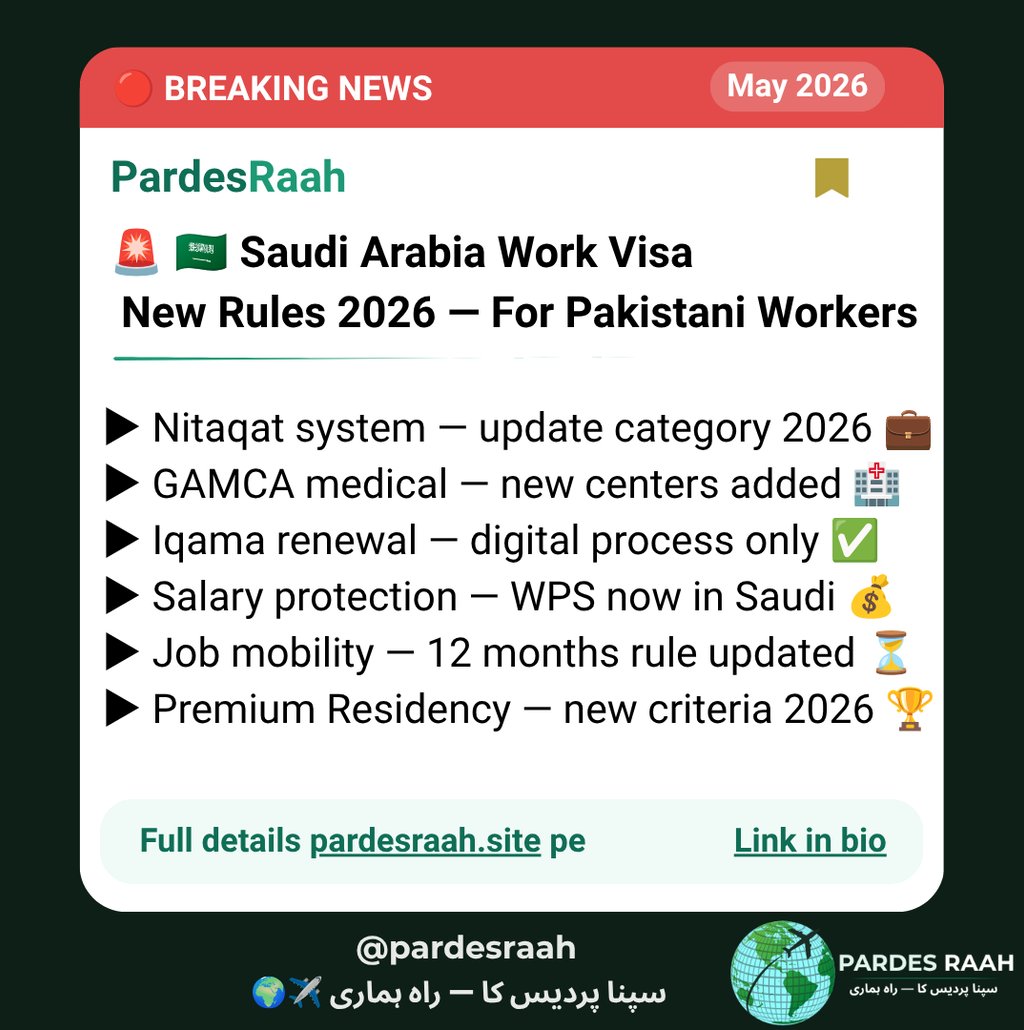
Update 1: Nitaqat System — Updated Categories 2026
The Nitaqat system is Saudi Arabia's workforce nationalisation program that requires all private sector employers operating in the Kingdom to maintain a minimum percentage of Saudi national employees — known as Saudisation — relative to their total workforce. Employers who meet their Nitaqat requirements receive a premium or green classification while those who fail to meet requirements are classified at lower levels with restrictions on their ability to recruit overseas workers including Pakistanis.
In 2026 the Saudi Ministry of Human Resources and Social Development has updated the Nitaqat classifications and percentage requirements across multiple industry sectors. These updates affect Pakistani workers in two key ways. First, employers in higher Nitaqat classifications have greater flexibility to recruit and retain overseas workers including Pakistanis — meaning Pakistani workers who are already employed by green or platinum Nitaqat companies are in a more stable position regarding their visa and employment status. Second, employers who fall into lower Nitaqat classifications due to insufficient Saudi workforce percentages may face restrictions on renewing overseas workers' visas — potentially affecting the Iqama renewal process for Pakistani workers employed by such companies. Pakistani workers in Saudi Arabia should verify their employer's current Nitaqat classification through the Mudad portal at mudad.com.sa and understand what their employer's classification means for their own employment stability and Iqama renewal eligibility.
Update 2: GAMCA Medical — New Approved Centres Added in Pakistan
The Gulf Approved Medical Centres Association, known as GAMCA, manages the network of approved medical examination centres whose fitness certificates are accepted by all Gulf Cooperation Council countries including Saudi Arabia for work visa purposes. The medical fitness examination — covering blood tests, chest X-ray, and general health assessment — is a mandatory requirement for all Pakistani workers applying for Saudi work visas.
In 2026 new GAMCA-approved medical examination centres have been added in Pakistan, expanding the network beyond the previously existing centres in Karachi, Lahore, Islamabad, and a limited number of other cities. The expanded network includes new centres in additional Pakistani cities — making GAMCA medical examinations more accessible for Pakistani workers from smaller cities and rural areas who previously had to travel significant distances to reach an approved centre. The complete and current list of GAMCA-approved medical centres in Pakistan is available at the official GAMCA portal at gcc-gcchmc.org. Pakistani workers planning to apply for Saudi work visas should check this updated list to identify the nearest approved centre to their location and book their appointment as early as possible as popular centres in major cities can have appointment waiting times of 1 to 3 weeks.
Update 3: Iqama Renewal — Digital Process Only Through Absher
The Iqama — the Saudi residence and work permit — must be renewed regularly to maintain legal residency and work status in Saudi Arabia. One of the most significant procedural changes in 2026 is that Iqama renewal is now conducted exclusively through the Absher digital platform — the official Saudi government e-services portal — and all paper-based or in-person renewal processes have been discontinued. This digitalisation is part of Saudi Arabia's broader Vision 2030 government services transformation.
For Pakistani workers this change has important practical implications. All Iqama-related transactions including renewal applications, status checks, and related services must now be initiated and managed through the Absher platform at absher.sa or through the Absher smartphone application. Pakistani workers who are not yet registered on Absher must complete their registration immediately using their existing Iqama details. Pakistani workers who manage their own Iqama-related processes — rather than having it handled entirely by their employer — must familiarise themselves with the Absher platform and ensure they have valid mobile number registration that allows them to receive OTP verification codes required for platform access.
Pakistani workers should also note that Iqama renewal remains the primary responsibility of the sponsoring employer under Saudi Kafala rules — the employer is legally obligated to renew the worker's Iqama before expiry. However Pakistani workers should proactively track their own Iqama expiry date and remind their employers of upcoming renewals well in advance. An expired Iqama results in daily overstay fines and creates complications for the worker's legal status. Iqama expiry dates can be checked through the Absher platform or by checking the physical Iqama card.
Update 4: Wage Protection System — Now Enforced in Saudi Arabia
One of the most worker-friendly developments in the 2026 Saudi Arabia labour landscape for Pakistani workers is the strengthened enforcement of the Wage Protection System, known as WPS. Saudi Arabia has been developing and expanding its WPS framework and in 2026 enforcement has been significantly strengthened — requiring employers to pay workers' salaries through official banking channels within the specified timeframe and subjecting non-compliant employers to meaningful penalties.
Under the WPS framework Pakistani workers in Saudi Arabia must receive their full contracted salary on time every month through an approved Saudi bank account. Employers who fail to pay salaries on time face escalating consequences — initial warnings, work permit freezes, and in serious cases referral for legal action. Pakistani workers who experience salary delays in 2026 should file a complaint through the Ministry of Human Resources and Social Development portal at hrsd.gov.sa or through the Musaned platform for domestic workers. The complaint process is free of charge and MHRSD is obligated to investigate salary complaints within specified timeframes.
Pakistani workers should maintain organised records of their salary payments — bank statements showing monthly credits, pay slips where provided, and any communications with their employer regarding salary matters. These records are essential evidence in any WPS complaint and help establish the pattern of payment or non-payment clearly. Pakistani workers in Saudi Arabia should download the Musaned app for domestic workers or the MHRSD app for other workers to access complaint filing and status checking services directly from their smartphones.
Update 5: Job Mobility — 12 Months Rule Updated
Job mobility — the ability of Saudi-based overseas workers to change employers — has been one of the most evolving aspects of Saudi labour law in recent years and 2026 brings a significant update that benefits Pakistani workers directly. Under the updated 2026 job mobility rules Pakistani workers can change employers without requiring the explicit consent of their current employer after completing 12 months of service — a reduction from the previous 2-year requirement that applied in earlier iterations of the mobility rules.
This 12-month job mobility right applies when the Pakistani worker has completed their initial 12-month work period and wishes to transfer to a new employer. It also applies — regardless of time served — if the employer has violated the employment contract through salary non-payment, contract substitution, or provision of unsafe working conditions. Pakistani workers who exercise their job mobility right must do so through the official transfer process on the Absher platform — informal job changes without completing the official employer transfer process leave the worker's visa status unresolved and create legal complications.
For Pakistani workers who are in difficult employment situations — facing exploitation, non-payment, or unsafe conditions — the 12-month job mobility rule combined with the WPS complaint mechanism provides a meaningful and legally supported pathway to protect themselves and seek better employment without the previous 2-year wait that made many Pakistani workers feel trapped in exploitative situations.
Update 6: Saudi Premium Residency — New Criteria 2026
Saudi Arabia's Premium Residency program — introduced in recent years as a structured long-term settlement option for high-value overseas residents — has been updated with new criteria and expanded eligibility pathways in 2026. The Premium Residency grants holders a renewable 5-year or permanent residency status in Saudi Arabia that is not tied to a specific employer sponsor — providing a level of independence and security that the standard Kafala-based work visa does not.
Under the 2026 updated criteria Pakistani professionals can apply for the Saudi Premium Residency through several qualifying pathways. The financial investment pathway requires an investment of SAR 800,000 in Saudi real estate or qualifying assets. The salary-based pathway requires a current monthly salary of SAR 20,000 or above with a minimum of 5 years of documented professional experience. Specialised talent pathways exist for professionals in fields designated as priority areas by the Saudi government including medicine, engineering, technology, research, and entrepreneurship. The Premium Residency fee for the permanent version is SAR 800,000 paid as a one-time fee — which is significant — while the annual renewable Premium Residency costs SAR 100,000 per year.
While the financial thresholds for Premium Residency place it beyond the reach of most Pakistani workers, senior Pakistani professionals and executives in Saudi Arabia who have spent years building their careers in the Kingdom and meet the salary or investment criteria now have a clearer and more structured pathway to long-term settlement than existed in previous years. Pakistani professionals interested in exploring Premium Residency eligibility should consult the official Saudi Premium Residency Centre at premium-res.moi.gov.sa.
Rights and Resources for Pakistani Workers in Saudi Arabia:
Pakistani workers in Saudi Arabia have a set of legal rights under Saudi labour law that are protected regardless of their employment category or salary level. These rights include the right to receive their contracted salary in full and on time, the right to a safe working environment, the right to retain their own passport, the right to 21 days of paid annual leave after one year of service, the right to end-of-service benefits equivalent to half a month's salary for each year of the first 5 years and one month's salary for each subsequent year, and the right to file a free labour complaint with the Ministry of Human Resources.
Pakistani workers who face violations of any of these rights should contact the Pakistan Embassy in Riyadh at mofa.gov.pk/riyadh for consular assistance, file a complaint through the MHRSD portal at hrsd.gov.sa, or contact the Pakistan Overseas Workers Welfare Board for support and guidance. Pakistani workers in genuine distress or danger should contact the Pakistan Embassy emergency line immediately.
Processing Time and Practical Notes:
Saudi work visa processing after the employer initiates the process through the Saudi Ministry of Human Resources typically takes 2 to 4 weeks. GAMCA medical examination results are typically available within 3 to 5 working days. Iqama issuance after arrival in Saudi Arabia typically takes 2 to 4 weeks. Iqama renewal through Absher is typically processed within 5 to 10 working days when all employer compliance requirements are met. Premium Residency applications are currently taking 3 to 6 months to process according to recent applicant reports.
Important Tips:
Download and register on the Absher platform immediately if you are currently in Saudi Arabia on a work visa — it is now the only portal for Iqama-related services and not being registered creates practical difficulties for all visa-related transactions. Keep a digital copy of your employment contract, Iqama, and all salary records stored in cloud storage accessible from Pakistan at all times. Never hand your passport to your employer — retaining your own passport is your right under Saudi labour law. Verify your employer's Nitaqat classification before accepting a job offer in Saudi Arabia — working for an employer in poor Nitaqat standing creates risks for your own visa status and renewal eligibility.
Conclusion:
The Saudi Arabia work visa rule updates in 2026 reflect a meaningful evolution in the Kingdom's approach to overseas worker management — with stronger salary protections, more accessible Iqama renewal through digital channels, improved job mobility rights, new GAMCA centre access, and updated Premium Residency pathways. For the 2.5 million Pakistani workers in Saudi Arabia and the thousands more planning to join them, understanding these updates is essential for protecting their rights, their income, and their legal status. Share this guide with every Pakistani worker and family you know who has a connection to Saudi Arabia — because informed workers are protected workers. Saudi Arabia mein apna haq jaano — 2026 ke naye rules Pakistani workers ki taraf hain.
For free visa guides, document checklists, and daily immigration updates made for Pakistani applicants follow PardesRaah on YouTube, Instagram, Facebook, TikTok and X.
سپنا پردیس کا — راہ ہماری ✈️🌍
© PardesRaah — Pakistan's #1 Visa & Immigration Media Hub


Sapna Pardes Ka — Raah Humari
Pakistan's free daily visa and immigration information hub.
Har roz naye guides — bilkul free.
Quick Links
Visa Categories
Popular Countries
© 2026 PardesRaah. All rights reserved.
Disclaimer: All information on PardesRaah is for educational purposes only. We are not immigration lawyers or consultants.