Schengen Visa New Rules 2026 for Pakistani Applicants
PardesRaah
7/1/20267 min read
Europe ka darwaza badal raha hai — digital, faster, aur thoda zyada strict. Sahi knowledge se yeh tabdeeli aap ke against nahi, aap ke saath kaam karti hai.
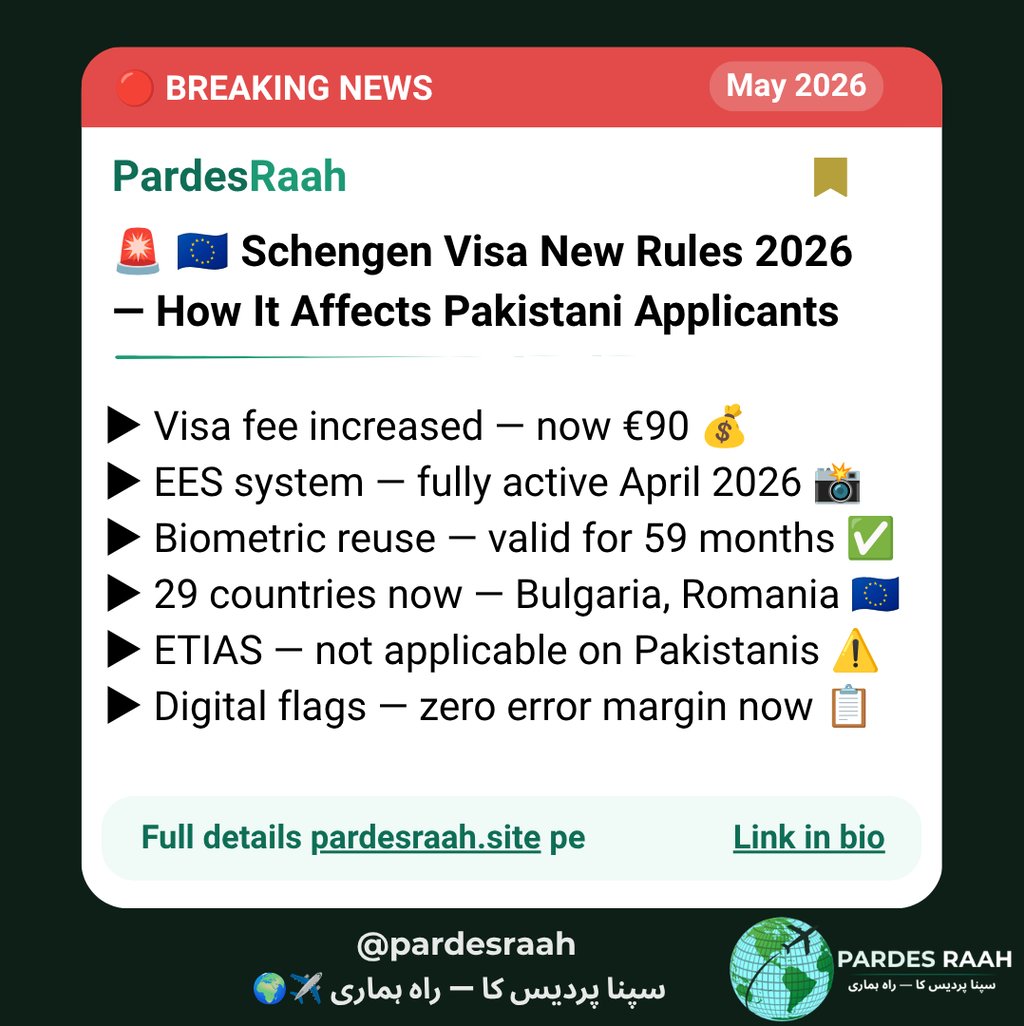
Schengen Visa New Rules 2026 — How It Affects Pakistani Applicants
Introduction:
The Schengen visa system has undergone some of its most significant changes in over a decade during 2026 — and Pakistani applicants planning trips to Italy, Germany, France, or any of the other Schengen member states need a clear understanding of exactly what has changed, what remains the same, and how these updates practically affect their application process. From the first fee increase in six years to the full rollout of the EU's new digital Entry/Exit System, an expanded Schengen Area now covering 29 countries, and a documentation standard with effectively zero tolerance for inconsistency, these changes reshape parts of the Schengen experience for Pakistani travellers without fundamentally altering the core process. This guide breaks down exactly what has changed in 2026 and what every Pakistani applicant needs to know before their next Schengen application.
What Is the Schengen Visa System?
The Schengen visa is a short-stay visa that allows non-EU nationals, including Pakistani passport holders, to travel freely within the Schengen Area for up to 90 days within any rolling 180-day period. In 2026, the Schengen Area includes 29 states, with Bulgaria and Romania having fully joined. The visa is applied for through the embassy or consulate of the primary destination country and processed through VFS Global or similar visa application partners in Pakistan.
Who Is Affected by These New Rules?
These 2026 updates affect every Pakistani national planning to apply for a Schengen visa for tourism, business, family visits, or short-term study, Pakistani applicants who have previously held a Schengen visa and are reapplying, and Pakistani travellers who will be entering the Schengen Area for the first time under the new digital border system.
Update 1: Schengen Visa Fee Increased — Now €90
For the first time since 2020, Schengen visa fees have increased in 2026. The standard adult visa fee has risen from €80 to €90, which is approximately PKR 31,000 at current exchange rates. The official reason cited is administrative costs and system upgrades needed for the new digital processing infrastructure. While any fee increase is unwelcome, the fee remained unchanged for six years between 2020 and 2025, so this represents a modest adjustment rather than a dramatic jump. The fee remains non-refundable whether the application is approved or rejected, and some applicant categories such as students conducting research or family members of EU citizens may still qualify for fee waivers. Pakistani applicants should budget the additional €10 per applicant into their overall Schengen trip planning.
Update 2: EES — The New Digital Border System Is Fully Operational
From 10 April 2026, the European Union's new Entry/Exit System, known as EES, became fully operational across all external Schengen borders. This is the most fundamental procedural change Pakistani travellers will encounter. The EES replaces manual passport stamping with biometric registration, recording each entry and exit digitally. On a Pakistani traveller's first entry into the Schengen Area in 2026, they will be required to provide high-resolution facial scans mapped against their biometric passport and digital fingerprints through a four-finger scan stored in a central EU database.
Pakistani travellers do not need to take any action before arriving at the border, and there is no cost for EES registration. However, Pakistani applicants should expect their first post-EES Schengen entry to take somewhat longer at passport control as this biometric registration is completed, and should build extra time into their airport arrival plans accordingly.
Update 3: Biometric Data Reuse — Valid for Up to 59 Months
A genuinely helpful change for returning Pakistani Schengen applicants concerns biometric data reuse. If a Pakistani applicant provided biometrics for a Schengen visa application within the last 59 months, they do not need to provide them again for a new application — even if applying to a different Schengen country than before. For example, a Pakistani applicant who gave biometrics for a French visa application in 2022 and is now applying for a German visa in 2026 can rely on those existing biometrics rather than attending a new in-person appointment for fingerprint and photo collection.
In countries where the option is available, this can allow Pakistani applicants to submit their documents by courier or mail rather than requiring an in-person VFS appointment for biometrics, since their existing biometric data remains valid. Pakistani applicants should check with VFS Global Pakistan whether their previous biometrics fall within this validity window before assuming a new in-person appointment is required.
Update 4: Schengen Area Now Covers 29 Countries
The Schengen Area now includes 29 member states following the full accession of Bulgaria and Romania, which abolished internal land border checks as of January 1, 2025. This means Pakistani applicants holding a Schengen visa now have visa-free access to two additional countries that were previously outside full Schengen membership. It's worth noting for Pakistani travel planning that Ireland, Kosovo, Turkey, and Cyprus remain outside the Schengen Area and are not covered by a Schengen visa.
For Pakistani applicants planning multi-country European itineraries, this expansion means Bulgaria and Romania can now be included as genuine Schengen destinations within the same visa and the same 90/180-day allowance, without requiring any separate visa application for those two countries.
Update 5: ETIAS — Clarifying What It Does and Does Not Mean for Pakistanis
There has been considerable confusion online about ETIAS, the European Travel Information and Authorisation System, and Pakistani applicants should understand clearly that this change does not apply to them. Starting in Q4 2026, visa-free travellers will need to obtain an ETIAS authorization before entering the Schengen Area, similar to the US ESTA system. However, ETIAS applies only to travellers from visa-free countries — Pakistani passport holders, who require a full Schengen visa, must continue to apply for the Schengen visa as before, and ETIAS does not replace this requirement.
Pakistani applicants should disregard any social media content suggesting ETIAS is a new simplified pathway available to them — for Pakistani nationals, the standard Schengen Type C visa application process remains entirely unchanged in terms of this specific requirement.
Update 6: Documentation Accuracy — Effectively Zero Margin for Error
With the EES creating a permanent digital record of every Schengen entry and exit, the practical standard for documentation accuracy in 2026 applications has tightened considerably. A minor typo in an applicant's accommodation address or a date mismatch on a bank statement is no longer treated as a simple oversight — it can be read by the increasingly data-driven and automated review process as a risk indicator.
This matters particularly for Pakistani applicants who are submitting their first-ever Schengen application. First-time applicants are treated by the system as having a "thin file" with no existing digital travel record in Europe, meaning consulates apply more rigorous scrutiny to intent and documentation consistency for these applicants specifically. Pakistani applicants who have previously travelled to other high-security destinations such as the US, UK, or Australia should ensure this travel history is prominently included in their application, as it functions as a positive credibility signal within the new system.
What Has NOT Changed:
It is equally important for Pakistani applicants to understand what has remained the same despite the headlines. The 90/180-day rule itself has not changed — Pakistani Schengen visa holders can still stay a maximum of 90 days within any rolling 180-day period across the entire Schengen Area. The core Type C short-stay visa requirements — passport validity, accommodation proof, return ticket, proof of funds, and travel insurance — remain fundamentally the same. Mandatory travel insurance with minimum €30,000 coverage is still required for every Schengen visa application, unchanged from previous years. Visa approval processing times also remain broadly similar to previous years, though early application continues to be strongly advised.
Practical Document Checklist Under the 2026 Rules:
Pakistani applicants preparing a 2026 Schengen application should ensure they have a valid passport with sufficient validity for the full trip and ideally beyond, confirmed and consistent accommodation proof such as a refundable hotel booking or rental confirmation, a confirmed return or onward flight ticket showing departure within the 90/180-day limit, proof of funds including bank statements, salary slips, or a sponsorship letter, and Schengen-compliant travel medical insurance covering the full duration of the stay. Every single detail across these documents — names, dates, addresses — must match exactly across the entire file given the heightened scrutiny under the new digital system.
Fees and Costs Summary:
The Schengen visa application fee is now €90 per adult applicant, approximately PKR 31,000. Children aged 6 to 11 continue to pay a reduced fee, typically around €45. VFS Global service charges in Pakistan remain approximately PKR 3,500 to PKR 5,500 per applicant. Travel insurance with minimum €30,000 coverage costs approximately PKR 5,000 to PKR 15,000 depending on trip duration and provider. EES biometric registration at the border carries no additional cost for travellers.
Processing Time:
Standard Schengen visa processing times for Pakistani applicants remain broadly consistent with previous years at approximately 15 working days for most applications, extending during peak summer travel season. Pakistani applicants should continue to apply at least 4 to 6 weeks before their intended travel date, with early application even more strongly recommended in 2026 given the additional scrutiny applied to first-time applicant files under the new digital system.
Important Tips:
Pakistani applicants who have previously held any Schengen visa should check the date of their last biometrics submission, as it may still be valid and could simplify their current application process. First-time Pakistani applicants should pay particular attention to building a credible and well-documented file, including prominently mentioning any previous travel to other strong-passport destinations. Triple-check every address, date, and figure across all submitted documents for perfect consistency, since the new digital system treats discrepancies more seriously than the previous manual review process. Budget for the new €90 fee per applicant when planning total trip costs, and continue using refundable hotel bookings and flexible flights when building the application file, finalizing non-refundable arrangements only after visa approval.
Conclusion:
The Schengen visa changes in 2026 represent meaningful modernization rather than a fundamental overhaul of the system Pakistani applicants have known for years. The fee increase is modest, the EES digital border system primarily changes how entries are recorded rather than what documents are required, biometric reuse rules actually benefit returning applicants, the expanded 29-country Schengen Area opens more destinations under the same visa, and ETIAS has no bearing on Pakistani applicants who continue to need a standard Schengen visa. The one genuine shift Pakistani applicants must take seriously is the tightened tolerance for documentation inconsistency under the new digital, data-driven review process. Prepare carefully, keep every detail consistent, and Europe remains an entirely achievable destination for well-prepared Pakistani travellers in 2026.
For free visa guides, document checklists, and daily immigration updates made for Pakistani applicants follow PardesRaah on YouTube, Instagram, Facebook, TikTok and X.
سپنا پردیس کا — راہ ہماری ✈️🌍
© PardesRaah — Pakistan's #1 Visa & Immigration Media Hub
Sapna Pardes Ka — Raah Humari
Pakistan's free daily visa and immigration information hub.
Har roz naye guides — bilkul free.
Quick Links
Visa Categories
Popular Countries
© 2026 PardesRaah. All rights reserved.
Disclaimer: All information on PardesRaah is for educational purposes only. We are not immigration lawyers or consultants.