Strong Ties to Pakistan for Any Visa Applications 2026
PardesRaah
6/9/20269 min read
Embassy officer ka sabse bada sawaal hota hai — kya yeh wapas aayega? Aaj unhe jawab do — apne documents se, apni kahani se.
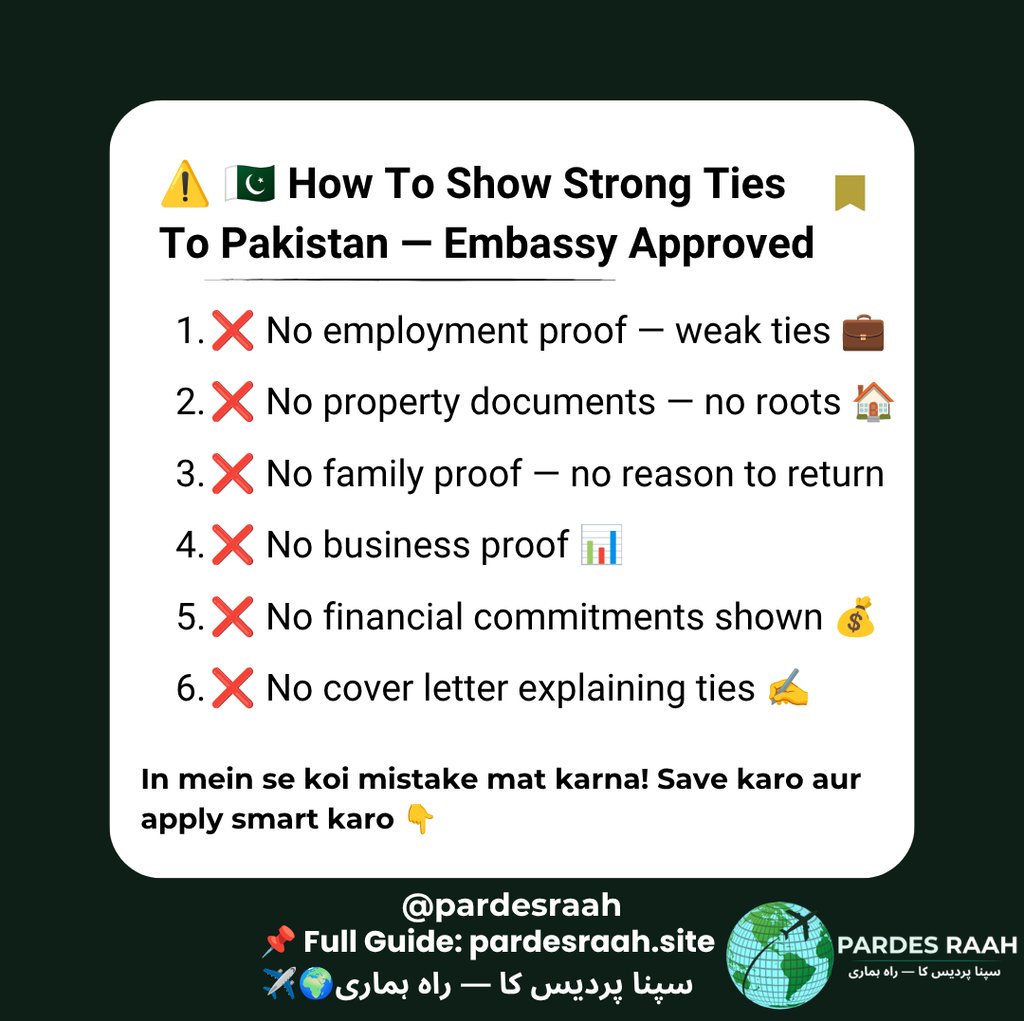
How To Show Strong Ties To Pakistan — Embassy Approved Method
Introduction:
Every single visa application submitted by a Pakistani passport holder — whether for a Schengen tourist visa, a UK visitor visa, a Canadian visitor visa, an Australian tourist visa, or any other short-stay or temporary visa — is evaluated against one central and overriding question in the visa officer's mind. That question is simple but profound: will this person return to Pakistan when their authorised stay ends? The answer to this question is what embassy and consulate visa officers are trained to find in every Pakistani application. And the evidence they look for is what immigration professionals call ties to the home country — the personal, professional, financial, and family connections that give an applicant genuine, documented, and compelling reasons to return to Pakistan after their trip. For Pakistani passport holders, demonstrating strong ties to Pakistan is not optional — it is the single most important factor in whether any temporary visa application succeeds or fails. This guide explains exactly what embassy-approved ties to Pakistan look like, how to document them correctly, and how to present them most effectively in any visa application in 2026.
Why Do Ties to Pakistan Matter So Much for Pakistani Applicants?
Pakistan's passport ranking and historical patterns of visa overstaying by Pakistani nationals have resulted in heightened scrutiny of Pakistani applications by embassies and consulates worldwide. Visa officers reviewing Pakistani applications start from a position of needing convincing evidence that the applicant will comply with visa conditions and return home — rather than assuming compliance as they might for applicants from stronger passport countries. This is not a reflection on any individual Pakistani applicant's character or intentions — it is a systemic reality of the current global immigration environment that Pakistani applicants must understand and address directly in every application.
The ties to Pakistan that an applicant demonstrates are the primary tool for overcoming this scrutiny. Strong, documented, and credible ties tell the visa officer that this particular Pakistani applicant has too much to lose by not returning home — a job they would lose, a family they would be separated from, property they would forfeit, a business they would abandon, and financial commitments they would default on. The stronger and more diverse these ties, the more convincing the case for visa approval becomes.
Who Should Read This Guide?
This guide is for every Pakistani passport holder who is planning any temporary visa application in 2026 — whether for tourism, family visits, business, study, or any other short-stay purpose. It is particularly valuable for Pakistani applicants who have previously been rejected for any visa and want to understand how to build a stronger ties-based case for their reapplication. It is also essential reading for first-time international visa applicants who want to start their visa journey with the strongest possible foundation.
Tip 1: Employment Proof — The Foundation of Ties
Employment in Pakistan is the single most universally recognised and respected form of tie to the home country across all embassy and consulate visa systems worldwide. A Pakistani applicant who has stable, documented employment in Pakistan with a salary, a job title, and an employer who has confirmed they will return to their position after the trip presents a powerful and credible core tie that immediately addresses the visa officer's primary concern.
The employment proof package for a visa application must be comprehensive and internally consistent. It must include a No Objection Certificate from the employer — written on official company letterhead, signed by an authorised representative, stating the applicant's name, designation, monthly salary, years of service, approved leave dates, and a clear statement that the company has no objection to the travel and that the position will be held open for the applicant's return. This must be accompanied by at least 3 months of salary slips showing regular and consistent salary credits that match the bank statement deposits. An employment contract or appointment letter is a valuable additional document that confirms the permanence and formality of the employment relationship. For salaried government employees — perhaps the strongest employment tie of all — a government employment certificate from the relevant department is exceptionally well regarded by all visa systems.
Pakistani professionals who are employed in senior positions, who have been with their employer for several years, who have upcoming professional responsibilities or projects, or who hold positions of authority that cannot easily be filled in their absence have the strongest employment-based ties. Mentioning these specifics in the cover letter — not just presenting the NOC — adds significant conviction to the employment tie argument.
Tip 2: Property Ownership — Roots in Pakistani Soil
Property ownership in Pakistan is one of the most powerful financial ties to the home country that a Pakistani visa applicant can demonstrate. Owning property in Pakistan — whether a residential house, a commercial property, agricultural land, or a plot — tells the visa officer that the applicant has significant financial assets in Pakistan that cannot be easily abandoned or transferred. It demonstrates that the applicant has invested in Pakistan, has financial roots in the country, and has tangible reasons to return and protect those investments.
Property ownership documents that should be included in a visa application include the property registration certificate or title deed showing the applicant's name as the registered owner, property tax payment receipts showing recent and regular payment of property taxes, utility bills for the property in the applicant's name, and if applicable a property valuation letter from a reputable property firm. For Pakistani applicants who own multiple properties or significant land holdings, providing a brief summary of the total property portfolio in the cover letter helps the visa officer appreciate the full extent of the applicant's financial roots in Pakistan.
Pakistani applicants who do not personally own property but whose immediate family members own significant property — particularly if the applicant is a co-occupant or beneficiary — should include relevant property documents with a brief explanation of their connection to the family property. A family home that the applicant has lived in for years and has every expectation of continuing to live in after their return is a meaningful tie even if the legal title is in a parent's name.
Tip 3: Family Ties — The Strongest Emotional Bond
Family ties to Pakistan are the most emotionally compelling and humanly convincing form of tie that Pakistani applicants can demonstrate. A visa officer reviewing an application from a Pakistani father who has a wife, three young children, and aging parents living in Pakistan has a very clear and intuitive understanding of why that applicant will return — because everything he loves and is responsible for is waiting for him at home.
The family ties documentation package should include the applicant's marriage certificate if married, children's birth certificates showing the names of dependent children living in Pakistan, a family registration certificate if available, and any documents that demonstrate ongoing financial responsibility for family members such as school fee receipts for children or evidence of supporting elderly parents. If the applicant's spouse is not travelling with them, the visa officer sees an even stronger tie — the applicant is leaving their partner and children behind in Pakistan which is one of the most powerful indicators of intended return.
Pakistani applicants who are not married or who have no dependent children should focus on other family tie documentation — a letter from elderly parents confirming the applicant's role as their financial or emotional support, evidence of regular financial transfers to family members, or documentation of family businesses or joint property ownership can all serve as meaningful family-based ties even in the absence of a spouse and children.
Tip 4: Business Proof — For Self-Employed Pakistani Applicants
Self-employed Pakistani applicants — business owners, entrepreneurs, freelancers, and professionals in private practice — face a specific challenge in demonstrating ties because they do not have an employer to issue them a NOC. But self-employment, when properly documented, can represent some of the strongest ties to Pakistan available. A Pakistani business owner who has invested years building their business, employs staff, serves clients, and manages ongoing operations has extremely strong ties that cannot simply be abandoned without significant personal and financial loss.
The business ties documentation package for self-employed Pakistani applicants must be thorough and professional. It should include the National Tax Number certificate showing registered taxpayer status in Pakistan, the business registration certificate from SECP or the relevant provincial registration authority, the chamber of commerce or trade body membership certificate if applicable, a business bank account statement showing regular business transactions over at least 6 months, individual tax return filings for the most recent 2 to 3 years, and a personal letter on business letterhead describing the business, its operations, its employees if any, and the applicant's specific role and responsibilities that make their return essential. For professional practitioners such as doctors, lawyers, or chartered accountants, their professional license or registration certificate is a particularly strong tie document that demonstrates significant professional investment in Pakistan.
Tip 5: Financial Commitments — Ongoing Obligations That Demand Return
Ongoing financial commitments in Pakistan are a highly practical and convincing form of tie that many Pakistani applicants overlook in their visa applications. A Pakistani applicant who has a home loan, a car finance agreement, a business loan, or any other significant ongoing financial obligation in Pakistan has a very practical and undeniable reason to return — because missing payments on these obligations has serious personal financial consequences.
Financial commitment documents that strengthen ties include home loan or mortgage statements from a Pakistani bank showing the outstanding balance and regular payment history, vehicle finance statements from a bank or finance company, business loan documents, insurance policy documents showing regular premium payments on life insurance or property insurance, and any other evidence of significant recurring financial obligations in Pakistan. These documents not only demonstrate ties but also show financial responsibility — a quality that visa officers regard positively in any applicant.
Investment account statements showing regular contributions to savings schemes, National Savings certificates, mutual fund investments, or the stock portfolio at the Pakistan Stock Exchange are also meaningful financial tie documents. They demonstrate that the applicant is actively building financial wealth in Pakistan — the opposite behaviour of someone planning to abandon their home country.
Tip 6: The Cover Letter — Tying Everything Together
The cover letter is the most underutilised and potentially most impactful document in any Pakistani visa application — and it is the tool that transforms a collection of individual documents into a coherent and persuasive narrative about why a specific Pakistani applicant will definitely return home. Many Pakistani applicants submit their visa applications with all the required documents but without any personal cover letter — leaving the visa officer to draw their own conclusions from a pile of documents without any explanatory framework.
A strong cover letter for demonstrating ties to Pakistan should be addressed formally to the visa officer, introduce the applicant by name and profession, state the purpose and dates of the intended visit clearly and specifically, and then systematically address each category of tie to Pakistan with a brief but convincing explanation. The employment section should mention not just the job title but specific responsibilities, upcoming projects, or professional commitments that make the applicant's return essential. The family section should personalise the family situation — naming the spouse and children and describing the family's dependence on the applicant's presence and income. The property section should briefly note the nature and value of property holdings. The financial commitments section should mention key ongoing obligations. The letter should close with a direct and confident statement of the applicant's intention to return to Pakistan immediately upon completion of their trip and their gratitude for the visa officer's consideration.
The cover letter should be professionally formatted on the applicant's personal letterhead or on plain white paper, be no longer than 1 to 2 pages, be written in formal and grammatically correct English, and be personally signed by the applicant. It should be placed at the very front of the visa application document file so it is the first thing the visa officer reads.
Which Ties Matter Most for Different Visa Types:
While all the ties described in this guide are valuable for every visa type, certain ties carry more weight in specific visa contexts. For Schengen tourist visas the financial ties — bank statement, property, financial commitments — and employment ties carry the most weight given the relatively short duration of the visit and the financial means assessment required. For UK visit visas employment ties and family ties are both heavily weighted. For Australian tourist visas property and financial ties are particularly important given Australia's thorough financial assessment. For Canadian visitor visas employment ties and family ties are the primary focus of the visa officer's assessment. Understanding which ties are most valued by the specific embassy you are applying to allows you to emphasise the most relevant tie documents in your application.
Processing Time Context:
Building strong ties to Pakistan documentation is not a last-minute task — it requires preparation that may span several months. Property documents, tax returns, and formal business registration papers take time to obtain. Bank statements demonstrating consistent financial positions must be built over months. Employment relationships that justify strong NOCs are built over years. Pakistani applicants who start thinking about their visa application 3 to 6 months in advance have the time to ensure every category of tie is fully documented and properly formatted before submission.
Important Tips:
Never fabricate or exaggerate any tie to Pakistan document — misrepresentation in a visa application is a serious offence that carries consequences far more severe than a simple rejection. Always ensure your cover letter and your supporting documents tell a consistent and mutually supporting story — any contradiction between what you write and what you document undermines the credibility of both. If your ties to Pakistan have genuinely changed since a previous rejection — for example you have purchased property, changed to a more senior job, or got married and had children — highlight these changes prominently in your reapplication to show the visa officer that your circumstances and your ties have strengthened since the previous decision.
Conclusion:
Demonstrating strong ties to Pakistan is not about trying to trick the system or manufacture convincing documents — it is about clearly and professionally communicating the genuine personal, professional, financial, and family connections that most Pakistani applicants already have but fail to document and present effectively. Employment, property, family, business, financial commitments, and a well-written cover letter together form a powerful and embassy-approved framework for proving to any visa officer in the world that you have every reason to return to Pakistan and no reason to stay abroad beyond your authorised period. Build these ties over time, document them carefully, present them confidently, and your visa applications will reflect the genuine trustworthy applicant that you are.
For free visa guides, document checklists, and daily immigration updates made for Pakistani applicants follow PardesRaah on YouTube, Instagram, Facebook, TikTok and X.
سپنا پردیس کا — راہ ہماری ✈️🌍
© PardesRaah — Pakistan's #1 Visa & Immigration Media Hub
Sapna Pardes Ka — Raah Humari
Pakistan's free daily visa and immigration information hub.
Har roz naye guides — bilkul free.
Quick Links
Visa Categories
Popular Countries
© 2026 PardesRaah. All rights reserved.
Disclaimer: All information on PardesRaah is for educational purposes only. We are not immigration lawyers or consultants.